About Astroscopus y-graecum (Cuvier, 1829)
This species, commonly called southern stargazer, has the scientific name Astroscopus y-graecum (Cuvier, 1829).
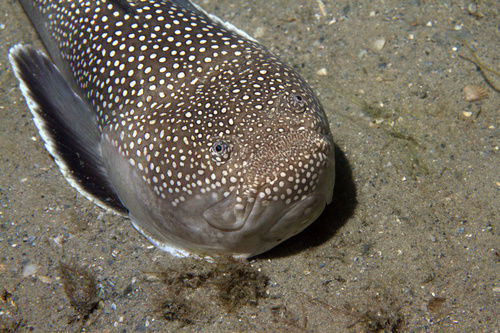
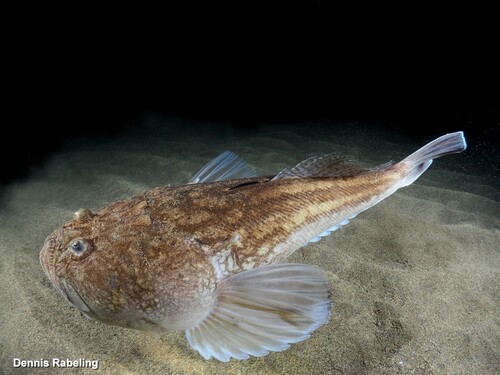
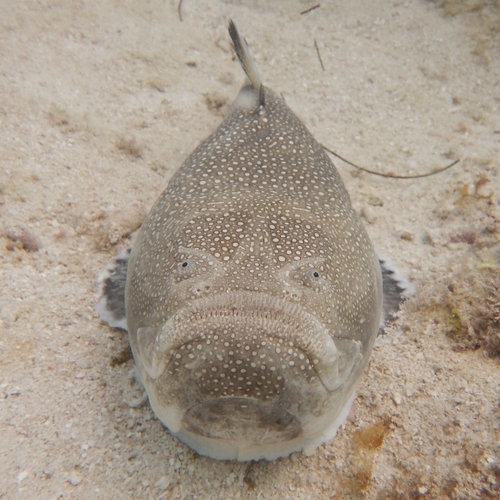
Description: Adult southern stargazers can reach a maximum total length of 440 millimetres, or 17 inches. Their bodies are brownish with small white spots, the outer edges of their pectoral fins are marked with alternating black and white lines, and their caudal (tail) fins display three black or brown stripes. They use their pectoral fins to dig and bury themselves in underwater sediment. Their fin ray counts are: 8 dorsal spines, 13–14 soft dorsal rays, no anal spines, and 13 soft anal rays. They possess a cleithral spine that is attached to a venom gland. When buried in sand, they leave their eyes, nostrils, and most of their mouth protruding above the sand surface.
To breathe, they draw water in through their nostrils, which are protected from sand by fleshy, comb-shaped fringes; identical protective fringes are also present on the mouth. Southern stargazers do not have scales on the top of their heads, but scales cover the rest of their bodies and extend onto the fleshy portion of the caudal fin. Their eyes can protrude slightly from the head to give a stalked appearance, which lets them see above the surrounding sand. An organ housed in a pouch behind their eyes allows the fish to generate an electrical current, which can reach up to 50 volts. This electric discharge is primarily used for defense rather than prey capture, and its strength depends on water temperature.
Habitat: Southern stargazers are benthic (bottom-dwelling) marine fish that associate with reef systems. They spend most of their lives in inshore waters, and can be found at depths down to 70 metres (230 ft) on substrates of sand, silt, or soft rubble.
Distribution: This species occurs in the western Atlantic Ocean, ranging from North Carolina south along the coast through the Gulf of Mexico to the Yucatán Peninsula. It is also found along the Caribbean coasts of Central and South America, from Mexico south to Rio de Janeiro, Brazil. It is not present in the West Indies.
Reproduction and life cycle: Spawning takes place in late spring and early summer. The fish spawn on the sea floor, and the small, transparent eggs slowly float upward to the water surface. After hatching, transparent larvae live in the open water column, and survive off nutrients from their yolk sac until they reach a length of approximately 6–7 millimetres (0.24–0.28 in). Once they reach this size, the larvae begin feeding on other small larvae in the water column. When larvae grow to 12–15 millimetres (0.47–0.59 in) in length, their electric organs begin to develop, and they move down to the sea floor to become juveniles.
Juveniles usually move inshore into sandy bays, and may remain there for multiple years. This is where juveniles develop all the characteristic features of adult southern stargazers; notably, their eyes shift from the sides of the head to the top of the head as they develop. Once juveniles reach approximately 30 centimetres (12 in) in length, they move offshore to become mature adults.