About Astroscopus guttatus Abbott, 1860
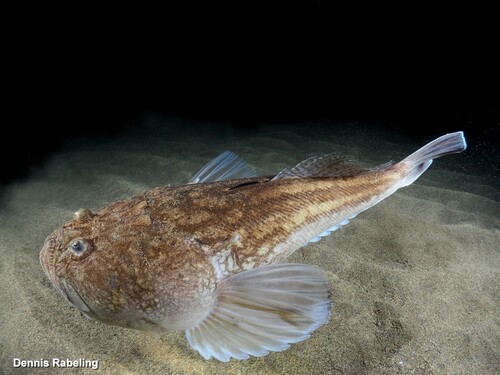
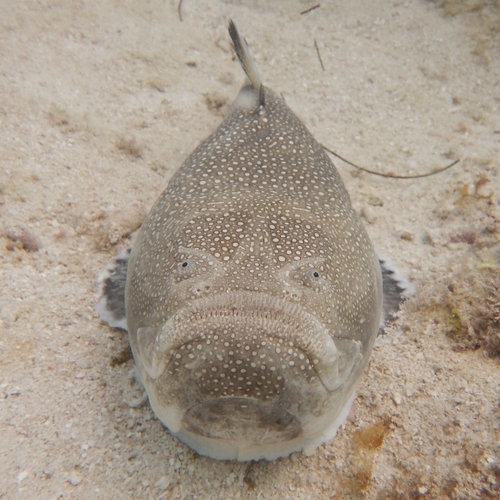
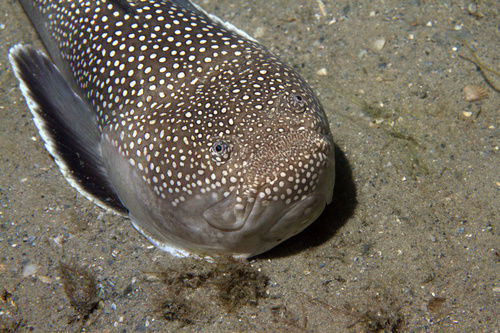
The northern stargazer, Astroscopus guttatus, has a blackish brown body covered in white spots that gradually increase in size toward the rear of its body. Three dark horizontal stripes mark its white tail. A key identifying trait shared by all Astroscopus stargazers is the unique path of the lateral line. While most fish species have a lateral line that follows a straight line or gentle curve along the body side, in Astroscopus, the lateral lines start at the gill opening then run sharply upward until the two lines sit almost together, one on each side of the dorsal fin. This adaptation lets the fish stay buried while keeping its lateral line functional. The southern stargazer, A. y-graecum, closely resembles the northern stargazer in both appearance and life history, but the two species can be told apart by two key features. First, look at the size and density of the white spots on the back: the northern stargazer has more closely spaced white spots, while the southern stargazer has larger, more widely spaced spots. Second, look at the tail striping: the northern stargazer’s middle tail stripe extends onto the rear portion of the body, while the southern stargazer’s stripe does not extend past the tail. Northern stargazers have a robust body covered in small scales that becomes more slender toward the posterior. They have four to five short spines on the dorsal fin and 13 to 15 rays on the second dorsal fin; their anal fin has one spine and 12 rays. The northern stargazer has many adaptations for its sand-dwelling lifestyle. It has an overall depressed body shape: a flattened elongated body with a large head and eyes positioned on the top of the head rather than the sides. This top placement lets the eyes remain functional even when the fish is buried. Along with eye placement, northern stargazers (like other bottom-dwelling fish) can change the height of their eyes by filling tissue at the back of the eye with body fluid. Their ventral fins are shifted forward to assist with digging, and their pectoral fins act as shovels, allowing the fish to bury itself in seconds. The stargazer’s mouth faces upward, letting it ambush prey while hidden in sandy coastal bottoms. When buried or in sand-filled water, Astroscopus can still breathe thanks to a row of fine comb-like structures along the edge of each jaw. When the jaw closes, these comb-like serrations interlock, letting water pass through while blocking sand. Electric organs sit in the orbits on the top of the stargazer’s head, behind and slightly under each eye. Each organ forms a vertical column that is roughly oval in horizontal cross-section, and the electric apparatus is made up of around 200 thin layers of electric tissue, that can generate and deliver an electric shock. Astroscopus guttatus is typically found in coastal waters ranging from New York to Virginia, though there have been confirmed sightings in the waters of South Carolina. It occurs at depths of up to 120 feet (37 meters), and favors rocky reef and soft bottom habitats. In areas without natural reefs, experiments placing oyster cages on the seabed observed increased fish diversity, including more frequent sightings of northern stargazers, as the cages provided additional reef-like habitat. Northern stargazers live primarily along the eastern seaboard of the United States. They swim slowly and clumsily, and do not swim much except when migrating. Instead, they bury themselves in sand using short side-to-side movements of their ventral fins and tail, until three-quarters of their body is covered by sandy substrate. If disturbed, they can bury themselves under as much as 12 inches of sand to hide from predators. They wait camouflaged in sand for prey to swim by, and primarily feed on small fish that pass above them. Their eyes sit on top of the head and poke up through the sand, which gives the species its common name stargazer. The electric organ sits under each eye; it is made of 200 thin layers of electric tissue, giving it a jelly- or mucus-like appearance. The origin of this organ is still undetermined, with the most supported hypothesis that it developed from an unusual modification of part of one or more eye muscles. The organ is thought to both deter predators from above while the fish is buried, and stun captured prey. The species’ scientific name Astroscopus guttatus translates roughly to “speckled one who aims at the stars,” referring to the white spots on its back and the upward-facing position of its eyes. Northern stargazers lay small, transparent eggs on bay bottoms in late spring to early summer. After release, the eggs float to the surface. They hatch into larvae that grow to 6–7 mm (0.24–0.28 in), and continue growing rapidly while feeding on their yolk sac. Once larvae reach 6–7 millimeters long, they begin eating other, smaller nearby fish larvae. After approximately one month, they slowly develop dark body coloration, and form their electric organs from eye muscle tissue when they reach 12–15 mm (0.5–0.6 in) in length. As juveniles, northern stargazers travel in schools; they leave the shoreline during winter to avoid severe cold, returning to bays in the spring. After four to six years of growth, they reach 12–13 inches in length, then migrate to permanent sandy bottoms some distance offshore. At this size, they become reproductively active, releasing gametes in early spring and breeding around May or June.