About Astrophytum asterias (Zucc.) Lem.
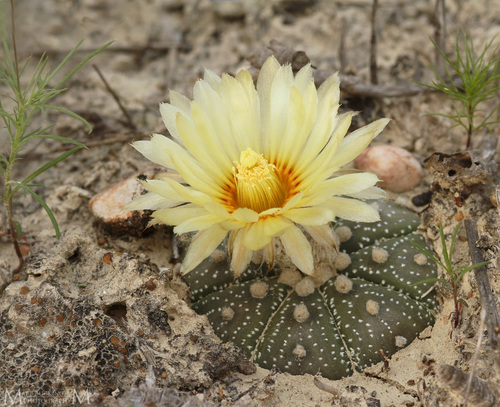
Astrophytum asterias (Zucc.) Lem. is a small, squat, round, spineless cactus. It grows 2.5 to 6 centimeters (1 to 2 inches) tall, and reaches 5 to 15 centimeters (2 to 6 inches) in diameter. Its disc-shaped body is split into 7 to 10 sections called ribs, and each rib has a woolly areole at its center. The body of the cactus is greenish-brown, and may look speckled due to a covering of white scales known as trichomes. Its flowers are yellow with red bases, and the outer portions of the flowers are very woolly. It produces oval fruits that range in color from green to pink, and the outer surface of these fruits is covered in woolly hairs. This species, commonly called star cactus, is native to the lower Rio Grande Valley of Texas in the United States, and to the Mexican states of Nuevo León and Tamaulipas, east of the Sierra Madre Oriental mountain range. Once more common across a larger area, the species is now restricted to a small portion of Starr County, Texas, and a small number of isolated sites in Tamaulipas. It is now found growing in thorn scrub on rocky ground; it likely previously occupied richer, flat grasslands that have since been developed for human use. Populations of this species are thought to have been completely eliminated from Nuevo León. Commonly called Sand Dollar Cactus, this species has been grown as a houseplant since the 1840s, similar to other members of its genus, even though it is rare in the wild. It is easy to propagate from seed, so most plants sold in nurseries are grown from seed. Its popularity among cactus collectors and hobbyists has led to the development of many available cultivars. One popular cultivar is 'Super Kabuto', a clonally propagated variety that has large trichomes that group into dense, striking patterned spots.