About Astropecten spinulosus (Philippi, 1837)
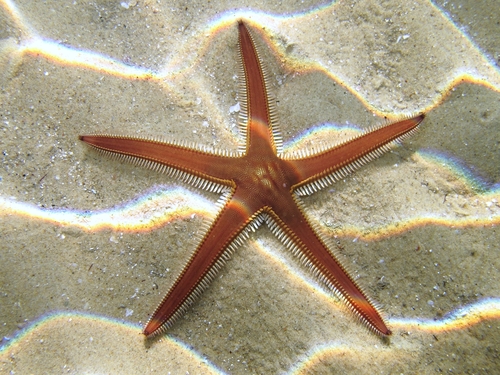
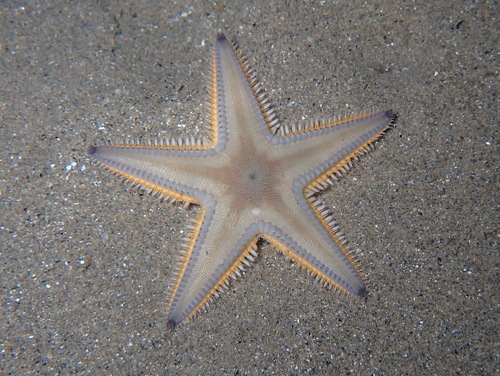
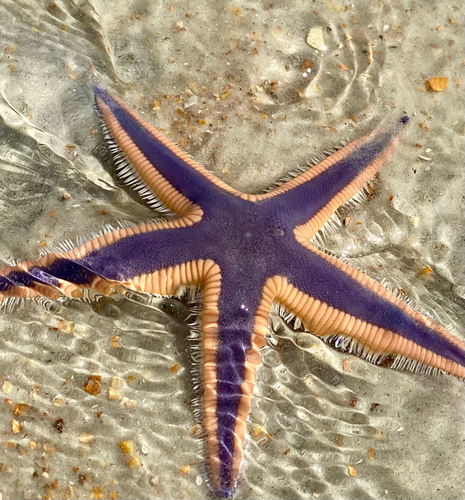
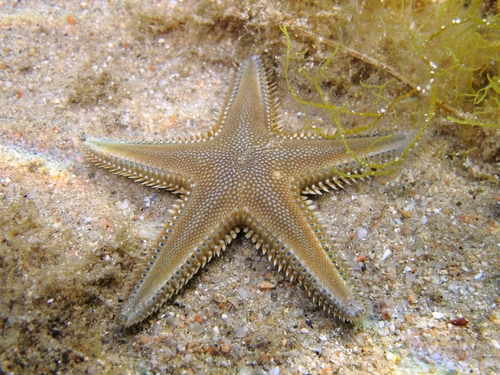
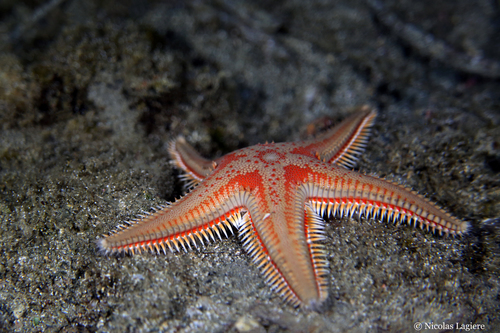
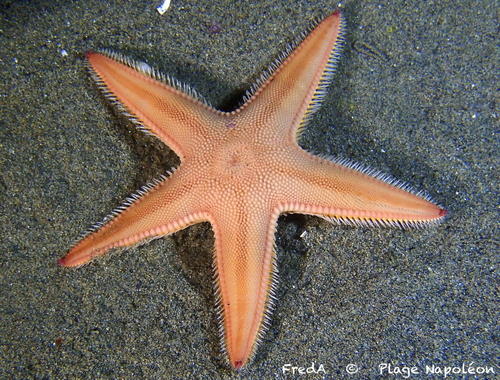
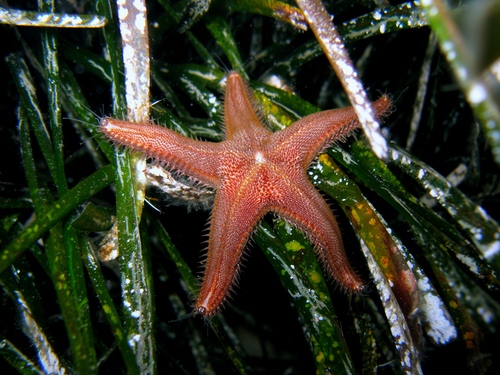
Astropecten spinulosus (Philippi, 1837) has very short superomarginal plates, where the height of the vertical face is slightly larger than the plate's width. These plates are completely covered in scales and very small spines. Only 1 to 3 small spines on the top of each plate qualify as true spines, while all other spines are too small to be considered true. These spines match the color of the superomarginal plates, which is brown or light brown. Its inferomarginal spines are long, pointed, and characteristically blue-purple. This species is a slender starfish, and sometimes has rounded arm ends. The aboral (upper) side is always a dark color: most often brown or reddish-brown, and rarely greenish. Unlike other species in the genus Astropecten, this species often moves away from mobile seabeds. It can be found on hard bottoms, in caves, or climbing on Posidonia oceanica. It is a small starfish, with a typical diameter of 6–8 cm, and a maximum diameter of just under 10 cm. This species can be identified by its very short superomarginal plates, the color of its aboral side, the color of its inferomarginal spines, and its small size. It can sometimes be confused with the related species Astropecten platyacanthus. Most starfishes in the genus Astropecten live on mobile seabeds (sandy, muddy, or gravel seabeds) and remain mostly buried under sediment during the day. In late afternoon and at night, they emerge to hunt, with bivalve molluscs as their preferred prey. Astropecten spinulosus lives only in the Mediterranean Sea. It prefers sandy seabeds near Posidonia oceanica or Cymodocea nodosa meadows, or other mobile seabeds in areas with very abundant algae, at depths between 1 and 50 meters. This species is active and easy to find during the night, and can sometimes be found in the late afternoon.