About Astropecten polyacanthus Müller & Troschel, 1842
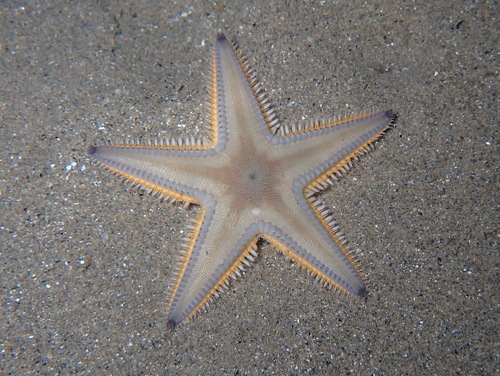
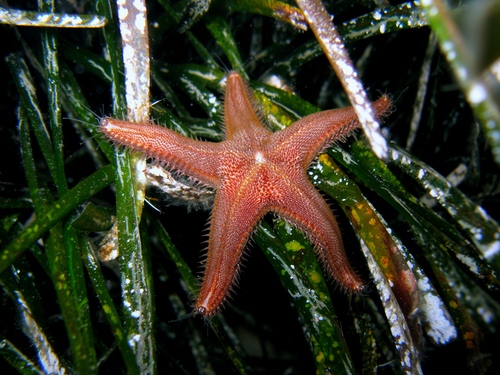
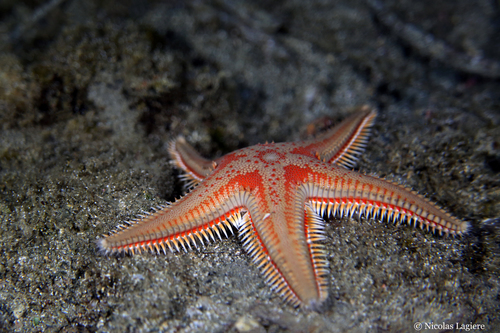
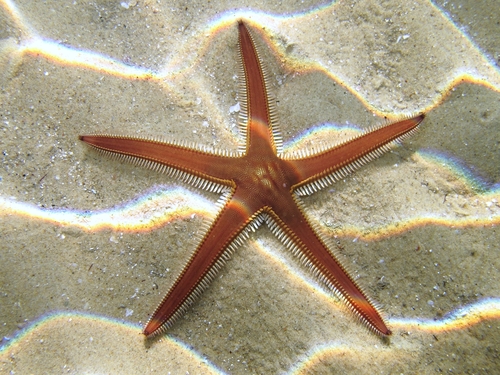
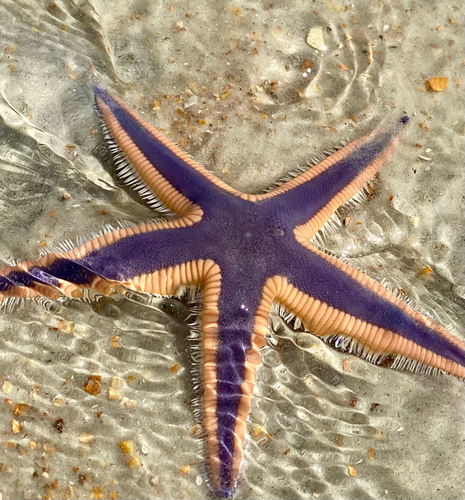
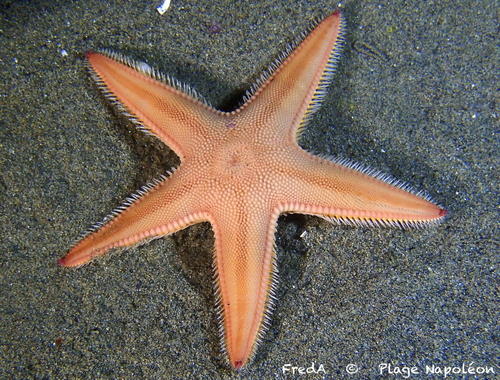
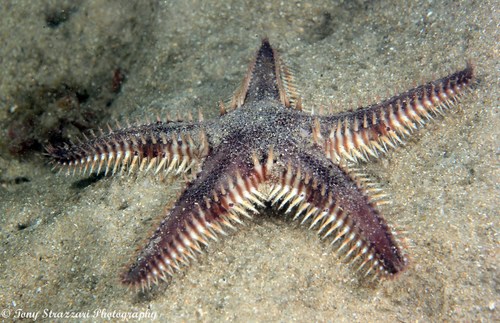
Commonly known as the comb star, Astropecten polyacanthus Müller & Troschel, 1842 has a dark purplish upper surface and an orange underside. Paxillae, small pillars with flattened summits whose Latin name means "little stakes", sit across the upper surface in shades of cream, grey, or brown; these colours sometimes form a chevron pattern. Along the edges of its five arms runs a fringe of long, sharp marginal spines, which usually have brown bases and pale tips. Its arms are fairly broad, reaching a maximum length of 9 centimetres (3.5 in). Instead of ending in suckers, its tube feet are pointed, a shape that works better for digging. This species can be confused with Archaster spp., which look similar because both evolved digging-adapted traits for moving through sand via convergent evolution. However, the two can be distinguished: Archaster has flat, blunt spines and parallel, radial rows of plates on its upper surface, features that Astropecten polyacanthus does not have. The comb star occurs in shallow tropical and sub-tropical seas across the entire Indo-Pacific region, ranging from the Red Sea and Zanzibar to Hawaii, and from Japan to Australia and New Zealand. In Australia, its range extends from Cape Naturaliste in the west, around the northern coast to Sydney in the east. It is most often found on silty sand bottoms in harbours and estuaries, and can occur at depths down to around 185 metres (607 ft). This species is sometimes kept in reef aquaria, where it efficiently clears detritus and uneaten food from sand or gravel. It is mostly nocturnal, and needs to be gradually acclimatized to the conditions of a home aquarium. If too many comb stars are kept in the same tank, they will starve.