About Astropecten platyacanthus (Philippi, 1837)
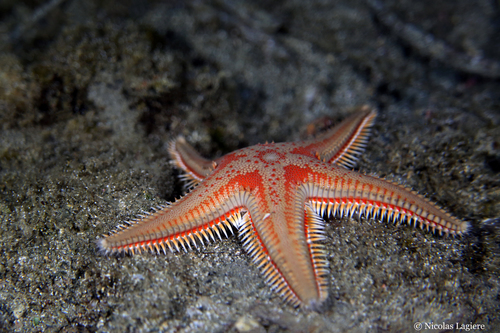
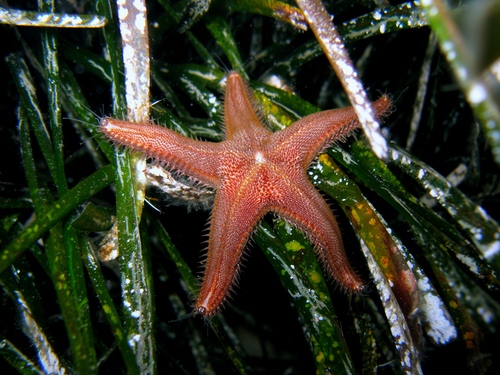
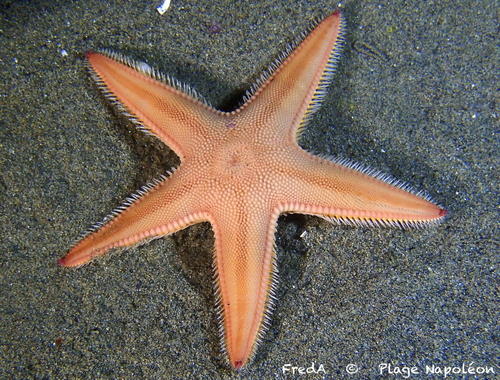
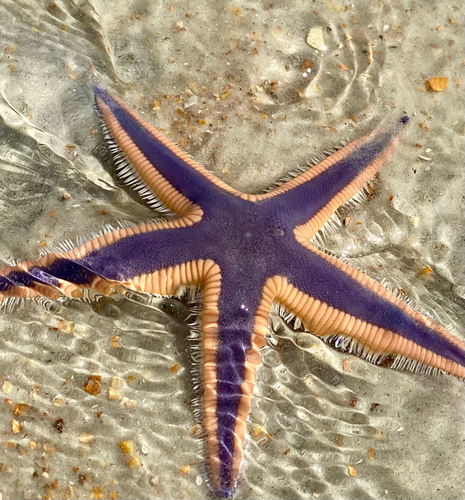
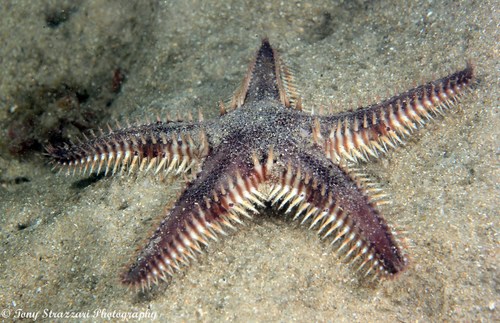
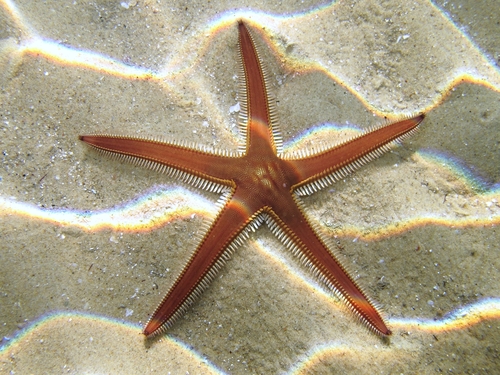
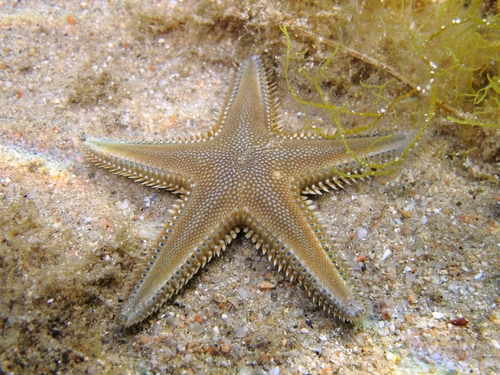
This species, Astropecten platyacanthus, has narrow, high superomarginal plates. The vertical lateral faces of these plates are covered with scales and small spines. Every superomarginal plate bears one strong spine, which is typically sharp but irregularly shaped, slightly flattened laterally, and most often yellow or orange, rarely off-white. In some cases, especially in young individuals, only the superomarginal plates between the arms bear a strong spine, while other plates do not; very rarely, all superomarginal plates lack spines entirely. This spine-free trait is very common in populations from certain regions of the Mediterranean, such as southern Corsica. Superomarginal spines sit more or less far from the inner edge of their plates, leaving a small bare area on the upper surface at the base of the spine. This bare area is white if the plate bears a strong spine, which is most common for plates near the central disc, and blue-violet if the plate has a very small spine or no spine, which is typical for plates toward the arm tips. The maximum number of superomarginal plates recorded per arm is 48; normally the number ranges between 29 and 43, depending on the size of the starfish. Inferomarginal spines are long, flat, and quite pointed. Astropecten platyacanthus is a highly variable species that can have either wide or narrow arms. The aboral (upper) side shows very variable coloration, and may be dark brown, olive green, pink-brown, or bluish-grey to varying degrees. The oral (lower) side is usually yellow-brown. Most individuals grow to a diameter of 9–12 cm, and exceptionally can reach up to 18 cm across. This is the most difficult Mediterranean Astropecten species to identify, due to both its high trait variability and its close resemblance to several other species. It is distinguished from Astropecten bispinosus most notably by superomarginal spines positioned far from the inner edge of the plate, leaving a small bare area on the upper surface at the spine's base. Another key distinguishing trait is that the vertical lateral faces of A. platyacanthus's superomarginal plates are covered in scales and small spines, rather than being smooth and bare. Additional differences include that A. platyacanthus has smaller, irregularly shaped, laterally flattened superomarginal spines, rather than the neat conical spines of A. bispinosus; on average, it also has fewer superomarginal plates per arm, a larger central disc, a darker oral side, and usually bears a small red spot at the tip of each arm. A. platyacanthus may also have less pointed inferomarginal spines than A. bispinosus on average. When compared to Astropecten spinulosus, A. platyacanthus has very different superomarginal plates: they are taller, more defined, and equipped with much larger, stronger spines. The overall appearance and color of the two species also typically differ: A. spinulosus is always more slender, dark brown, with brown superomarginal spines and blue-purple inferomarginal spines. A. platyacanthus reaches or exceeds 10 cm in diameter, while A. spinulosus grows to a maximum of just under 10 cm. Young A. platyacanthus can sometimes be confused with Astropecten jonstoni due to similar overall appearance and color, but the two are always easily distinguished by clear differences in their superomarginal plates and spines. Like all species in the genus Astropecten, A. platyacanthus lives on mobile seabeds (sandy, muddy, or gravel seabeds) and remains mostly buried under sediment during the day. In late afternoon and at night, these starfish emerge to hunt, with bivalve molluscs being their preferred prey. This species occurs only in the Mediterranean Sea, where it inhabits all types of mobile seabed at depths between 1 and 60 m. It is most frequently found on seabeds of mixed coarse sand and mud at depths of 1–4 m. This species is active and easy to find at night, as well as during the day, particularly in the early morning and late afternoon.