About Astropecten jonstoni (Delle Chiaje, 1827)
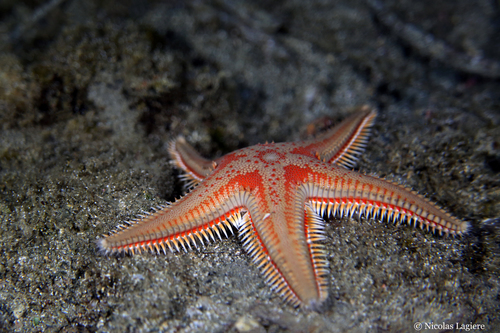
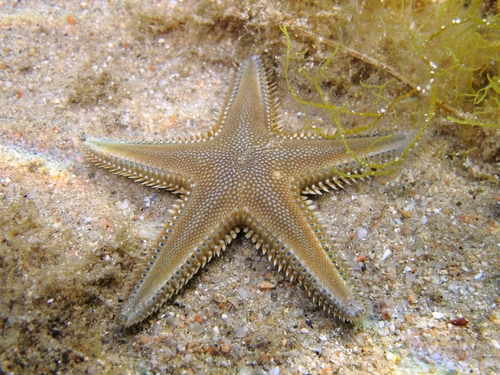
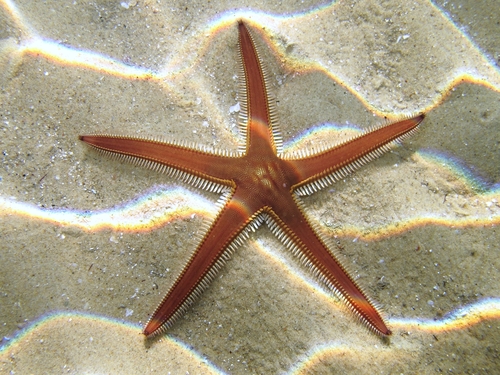
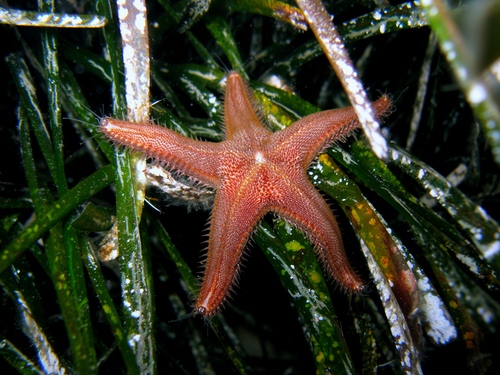
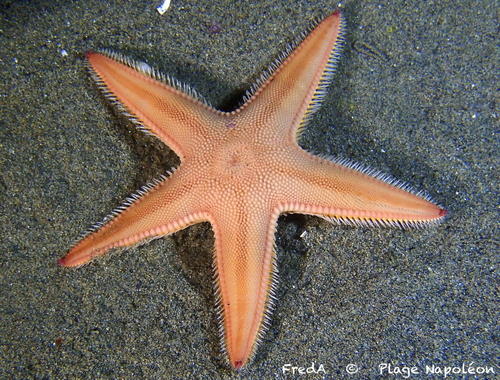
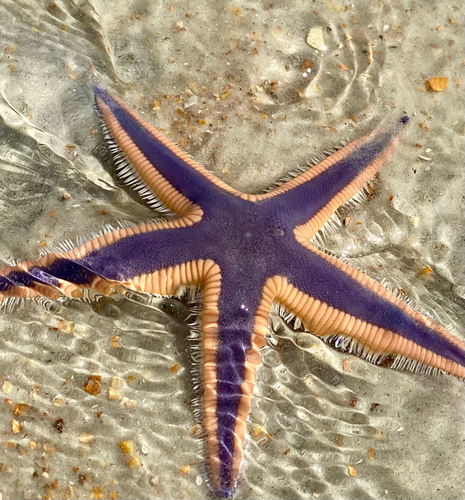
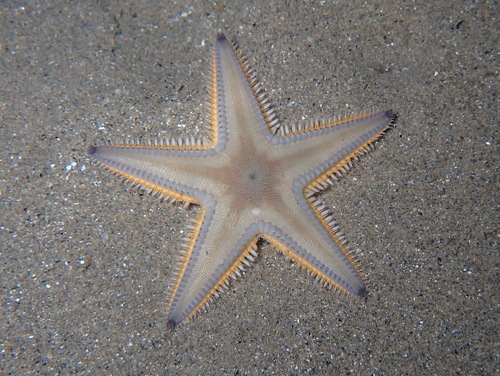
This sea star, Astropecten jonstoni, has superomarginal plates that either have very short spines or lack spines entirely; the plates between the arms are usually spine-free. Its inferomarginal plates each bear a short, thick external spine. These spines are arranged very regularly, normally held parallel to one another and are quite rigid. Inferomarginal spines are dark orange at the base, and white-yellowish toward the tip, which creates a sort of orange outline along the base of the sea star. This species has a very distinctive overall shape: it has a larger disc than other related species, with rather short, triangular, very pointed arms that emphasize the classic star shape. The aboral (upper) side is fairly pale, with various shade variations that can lean toward beige, turquoise-green, or grey-brown. It is the smallest species of Astropecten found in the Mediterranean Sea, reaching a maximum diameter of about 7 to 8 cm. Astropecten jonstoni has many distinct features and can be easily identified by its overall shape, size, and colour. It is rarely confused with very young specimens of Astropecten platyacanthus. Members of the genus Astropecten generally live on mobile seabeds including sandy, muddy, or gravel seabeds, and remain mostly buried under sediment during the day. In late afternoon and at night, these sea stars emerge to hunt, primarily preying on bivalve molluscs, their favourite prey. Unlike other species in the genus Astropecten, A. jonstoni is active and easy to find during the day, especially in early morning and late afternoon. This species lives exclusively in the Mediterranean Sea, and prefers shallow sandy seabeds between 1 and 12 metres deep.