About Astropecten irregularis (Pennant, 1777)
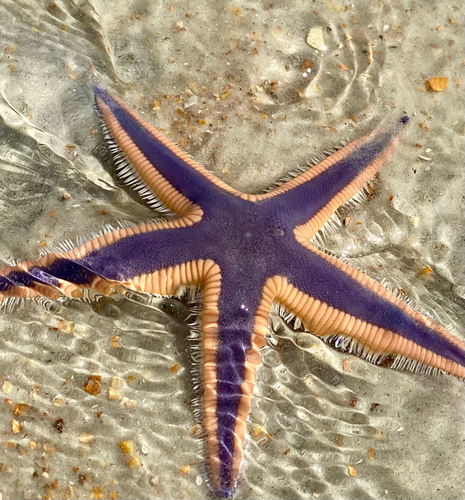
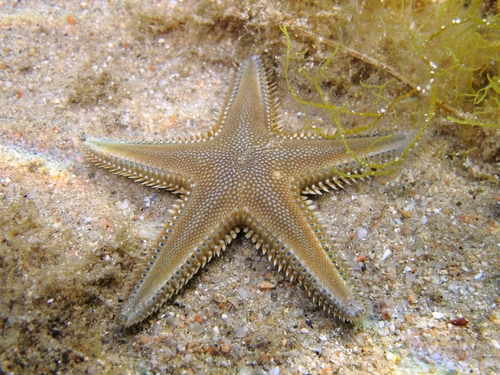
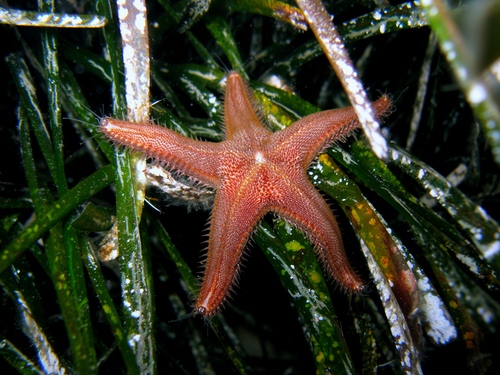
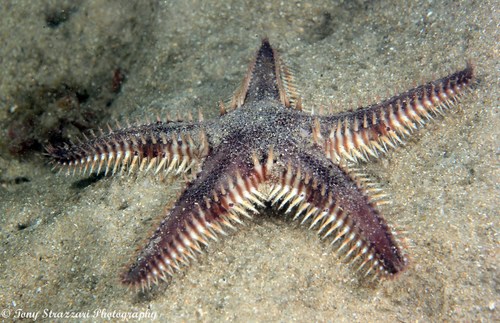
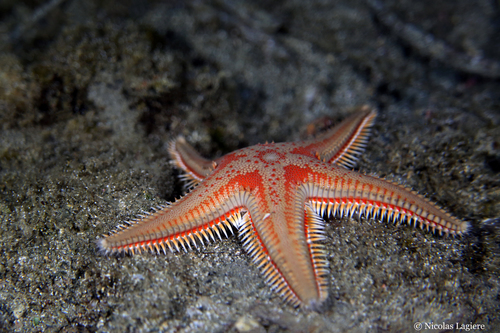
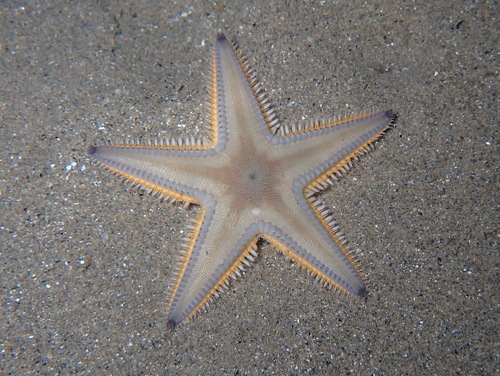
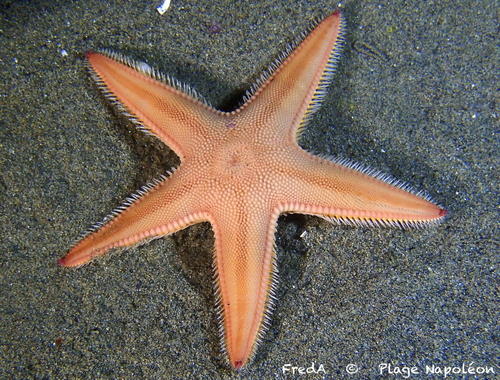
Astropecten irregularis, first described by Pennant in 1777, is a species of starfish that occurs in both the Atlantic Ocean and the Mediterranean Sea. The two geographic populations have distinct differences in their superomarginal plates. All Mediterranean specimens completely lack spines on their superomarginal plates; some authors classify this population as the subspecies Astropecten irregularis pentacanthus. Atlantic populations have spines on their superomarginal plates: populations with one spine per plate are classified by some authors as the subspecies Astropecten irregularis irregularis, while populations with multiple spines are either classified as the subspecies Astropecten irregularis serratus by some authors, or treated as a variety of Astropecten irregularis irregularis by others. This species has well-developed, raised superomarginal plates. The inferomarginal plates of this starfish are short and thin, bearing fine, highly mobile spines and are white in colour. Unlike other related starfish species, Astropecten irregularis does not hold these spines rigid and parallel to one another. At the base of its arms where they attach to the central disc, the arms form very distinct, sharp angles. The aboral (upper) side of the starfish is uniformly pink, often darkening to violet towards the arm tips, and may sometimes have numerous small darker spots across the central disc. Many individuals have a well-developed bulge at the center of the disc called the aboral-cone. This cone protrudes above the sediment the animal is buried in, and serves a respiratory function. This starfish typically reaches a diameter of 10–12 cm, with a maximum recorded diameter of 19 cm. Astropecten irregularis is a very common species that inhabits all types of mobile seabeds, at depths ranging from 1 meter to approximately 1,000 meters. In the Mediterranean, it can usually be easily and reliably distinguished from other starfish species by its spineless superomarginal plates and its characteristic colouration. It is sometimes confused with Astropecten aranciacus due to their similar colour, but the two species can always be told apart by closer examination of their superomarginal plates, inferomarginal spines, or the colour of their paxillae. Like other members of the genus Astropecten, this species lives on mobile seabeds including sandy, muddy, or gravel seabeds, and remains mostly buried under sediment during the day. It becomes active to hunt in late afternoon and at night, with bivalve molluscs as its preferred prey. It is easiest to find at night, and can occasionally be found in late afternoon.