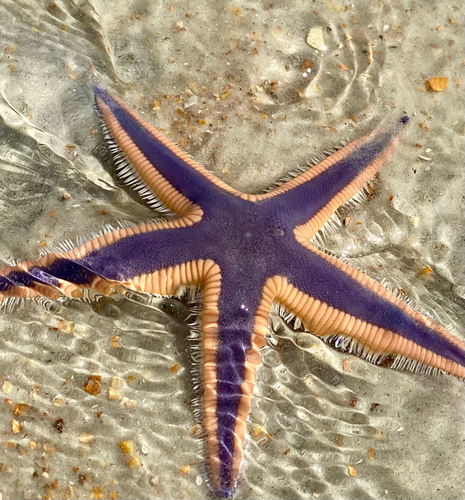
About Astropecten articulatus (Say, 1825)
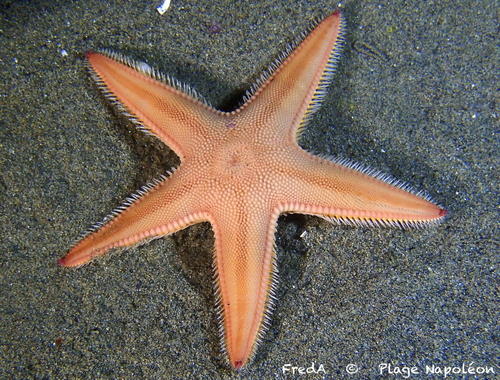
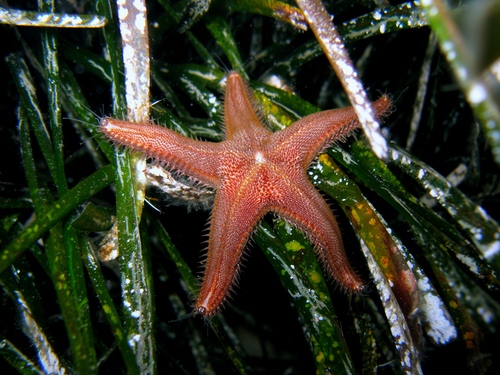
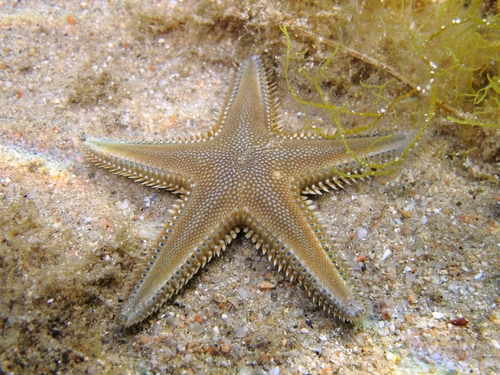
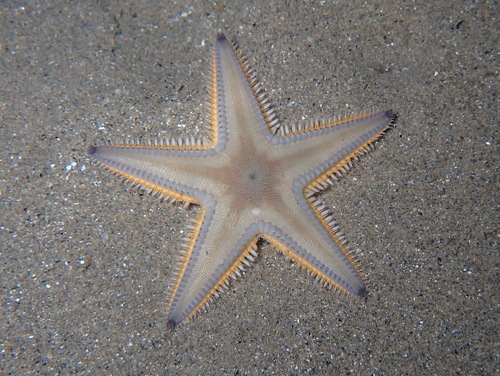
Commonly called the Royal Starfish, this species has bold, distinctive coloration. Its central body region, known as the disk, has a purple, granulated texture, and this purple color extends out along its five arms. The outer outline margin of the sea star is bright orange. Entomologist Thomas Say, who first described the species, noted the margin is “articulated throughout”, meaning the continuous orange margin runs uninterrupted even at the joints between the arms. White spines attach to this orange margin, and tube feet are found at the tips of the arms. These tube feet are cylindrical with conical ends, and their epithelial tissue is covered by a thin cuticle. Beneath the epithelium lies nervous tissue, followed by fibrous tissue arranged in both left and right helices that overlay and protect the underlying muscle tissue layer of the foot. Each tube foot also contains a bilobed structure called an ampulla; the muscle layers of the ampulla enable the tube foot to elongate and shorten, which powers the sea star’s movement. The Royal Starfish is morphologically very similar to the Red Comb Starfish. Historically, researchers believed the two species could be distinguished by the shape of disk granules: Red Comb Starfish were said to have needle-like granules, while Royal Starfish were thought to have spherical granules. However, more recent research has found that Royal Starfish granules are not actually spherical, and this apparent spherical shape is caused by folding of the tissue. This species occurs along the east coast of continental Americas, and is found particularly often in the Caribbean.