About Astronotus ocellatus (Agassiz, 1831)
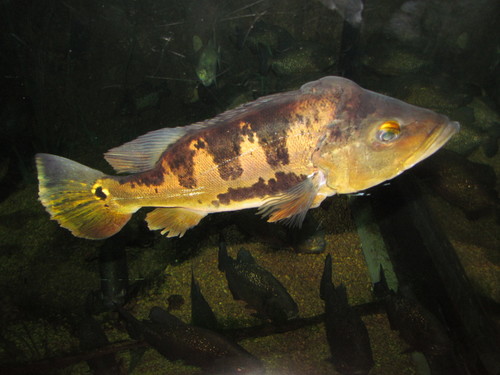
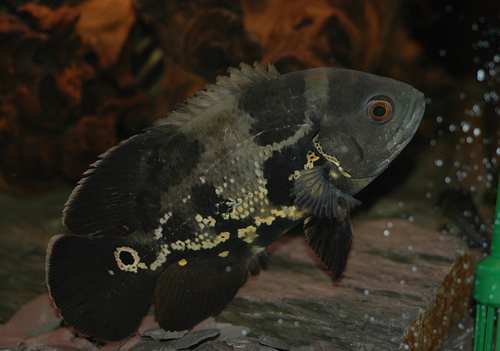
Astronotus ocellatus (Agassiz, 1831) individuals have been reported to reach around 70 cm (28 in) in length and 9 kilograms (20 lb) in weight. Wild-caught specimens of this species are typically dark in color, with yellow-ringed spots called ocelli on the caudal peduncle and dorsal fin. Researchers have suggested these ocelli work to reduce fin-nipping from piranhas of the genus Serrasalmus, which share the same natural environment as A. ocellatus. This species can also rapidly change its coloration, a feature that supports ritualized territorial and combat behaviors between members of the same species. Juvenile oscars have different coloration than adult individuals: they have wavy white and orange striped patterns, and spotted heads. A. ocellatus is native to Brazil, Colombia, Ecuador, Guyana, French Guiana, Suriname, Peru, and Venezuela. It is found in the Amazon River basin, along the Amazon, Içá, Negro, Solimões, and Ucayali River systems, and also lives in the Approuague and Oyapock River drainages. In its natural habitat, the species typically lives in slow-moving white-water environments, and has been observed sheltering under submerged branches. Feral populations also exist in China, northern Australia, and Florida, USA, introduced accidentally as a side effect of the ornamental fish trade. The species' distribution is limited by its inability to tolerate cooler water temperatures; its lower lethal temperature is 12.9 °C (55.22 °F). While this species is widely considered sexually monomorphic, research suggests males grow more quickly, and in some naturally occurring strains, males have dark blotches on the base of their dorsal fins. The species reaches sexual maturity around one year of age, and continues reproducing for 9 to 10 years. The frequency and timing of spawning may be connected to rainy periods. A. ocellatus are biparental substrate spawners, though there is very little detailed information about their reproduction in the wild. In captivity, breeding pairs select and clean generally flattened horizontal or vertical surfaces to lay their eggs. Smaller females lay around 300 to 500 eggs, while larger female oscars can lay 2,500 to 3,000 eggs. Like most cichlids, A. ocellatus provides brood care, though the duration of brood care in the wild is still unknown. Oscar fish are omnivores. Most fish eaten by A. ocellatus in the wild are relatively sedentary catfish, including species from the genera Bunocephalus, Rineloricaria, and Ochmacanthus. The species uses a suction mechanism to capture prey, and has been reported to use "lying-on-side" death mimicry, similar to the behaviors seen in Parachromis friedrichsthalii and Nimbochromis livingstonii. Wild oscars also eat shrimp, snails, insects and insect larvae, as well as seasonal fruits and nuts. The species has an absolute requirement for vitamin C, and develops health problems if it does not get enough of this nutrient. Captive oscars generally eat fish food formulated for large carnivorous fish, as well as natural foods such as crayfish, worms, and insects including flies, crickets and grasshoppers.