About Astrolepis integerrima (Hook.) D.M.Benham & Windham
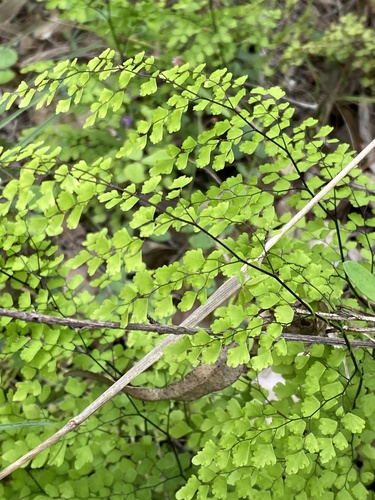
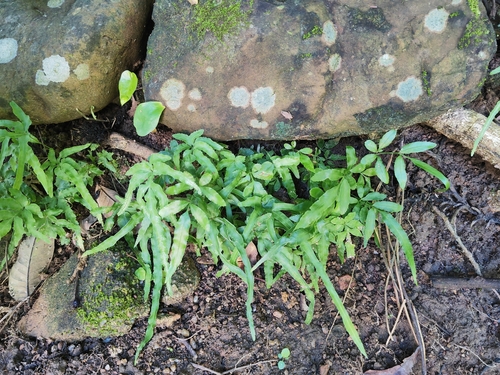
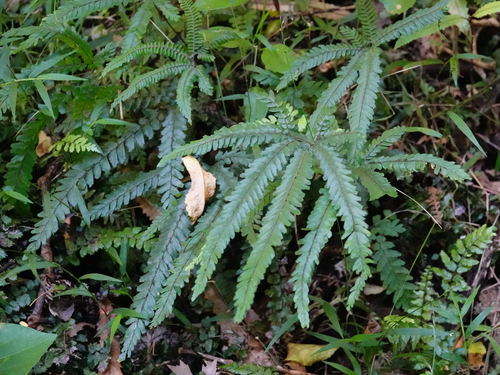
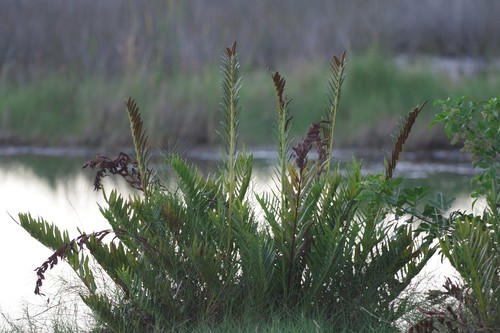
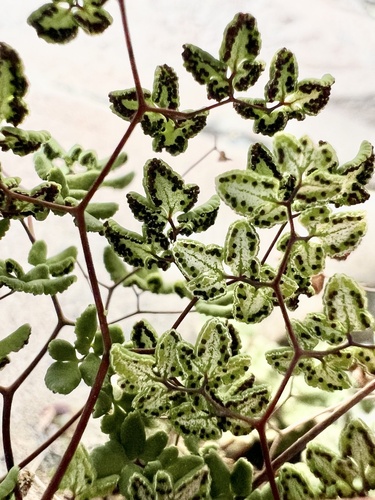
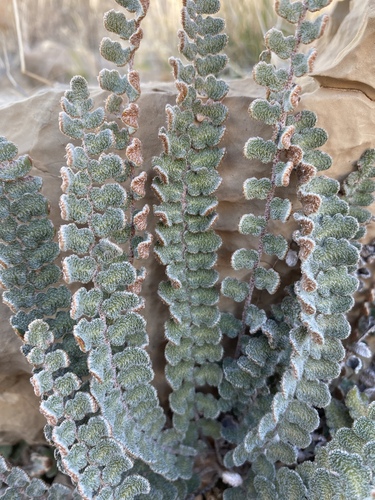
Astrolepis integerrima (Hook.) D.M.Benham & Windham is a small to medium-sized fern, with leaves measuring 8 to 45 centimeters long. Each leaf is composed of 20 to 45 pairs of smaller leaflets called pinna. The leaf division ranges from 1-pinnate to pinnate-pinnatifid, meaning pinna are sometimes partially divided less than halfway toward the midline. The leaflets are oblong to ovate (egg shaped), and the largest leaflets reach 7 to 15 centimeters long. When leaflets are lobed, they have 2 to 7 lobes total, which are asymmetrical and broadly rounded. The underside of the leaflets is completely covered in spear-point-shaped scales, most often 1 to 1.5 millimeters long, and these scales nearly conceal the entire lower surface of the leaf. The upper sides of the leaves are covered in scales that are either stellate (star-shaped) or coarsely ciliate (resembling rough hairs). When plants produce sporangia in late summer or fall, each sporangium contains 32 spores. The stems of this fern are compact, covered in very small scales that reach at most 15 millimeters long. These scales are either uniformly tan, or tan with a darker base, and have either smooth edges or small hairy teeth, described as ciliate-dentate. Most of the distribution of Astrolepis integerrima centers on northern Mexico and parts of the southwestern United States. It is widespread in northeastern Mexico, and only rare or absent in the states of Durango, Tamaulipas, and Zacatecas. In northwestern Mexico, it is rarely, if ever, found outside of Sonora. In central Mexico, it occurs rarely in the State of Mexico and Puebla, and is occasionally found growing in Veracruz. In southeastern Mexico, it is only found in Chiapas, and only occurs rarely there. In southwestern Mexico, it occurs in Oaxaca, is sometimes found in Guerrero, and is very rarely found in Jalisco or Nayarit. In the southwestern United States, Astrolepis integerrima occurs in Arizona, New Mexico, and Texas, and is very rarely found in Colorado and Nevada. Small populations also occur in Oklahoma, near the Texas border. An isolated population grows in Alabama, more than 900 kilometers away from the species’ nearest populations in Texas, where it grows in two dolomitic cedar glades. The species has occasionally been observed or collected in the Dominican Republic; there is one collected specimen from Haiti, collected in 1925, and another collected specimen from Guatemala, collected in 1962. A recent human observation of this species was made in June 2023 in Chile, but this occurrence has not yet been confirmed by scientific collection. Astrolepis integerrima prefers the uncommon habitat of rocky hillsides and cliff clefts. It most often grows on limestone, sandstone, or other calcareous rocks, and can be found at altitudes ranging from 500 to 1800 meters.