About Astroides calycularis (Pallas, 1766)
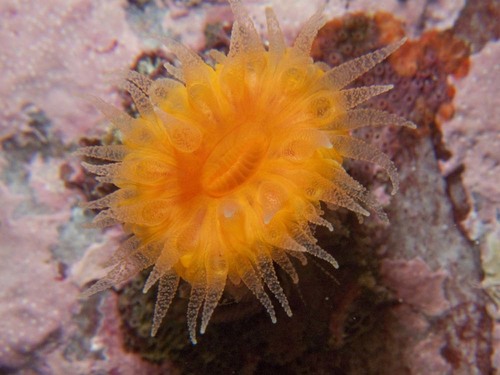
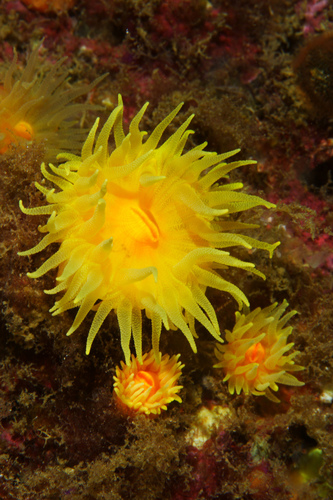
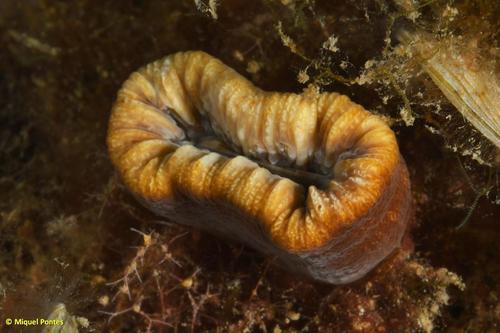
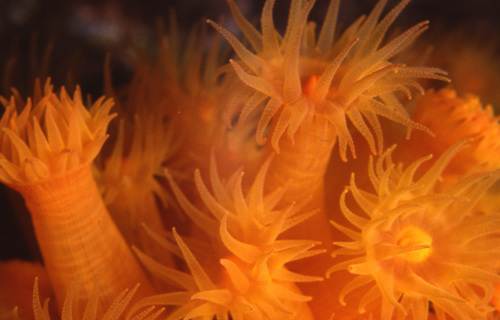
Astroides calycularis is a colonial coral made up of individual polyps, each seated inside a stony cup called a calyx. Colonies grow to 25 to 30 cm (10 to 12 in) in diameter and 10 cm (4 in) in height, and each individual polyp measures about 1 to 2 cm (0.4 to 0.8 in) in diameter. Polyps are yellow or orange, with a fringe of roughly thirty very short tentacles surrounding a slit-shaped mouth. Colonies grow via asexual reproduction, with new polyps budding off existing polyps and secreting their own calices. Colonies in deep water form a bush shape, have circular calices, and budding takes place at multiple heights on the calyx walls. Shallow-water colonies are typically ellipsoid, have polygonal calices, and budding occurs both in the center and around the edges of the colony.
During the Pleistocene, Astroides calycularis had a broader distribution than it does today, and was found across the entire western Mediterranean. After glaciation caused lower sea temperatures, the species disappeared from the northern part of its former range. Currently, it is native to the western Mediterranean Sea south of Sardinia, and is also found in the Atlantic Ocean near the Strait of Gibraltar. Before 1989, it was only found west of Sicily, but in 1989 it was recorded in the Adriatic Sea for the first time. This range expansion coincided with a sudden shift in eastern Mediterranean circulation, which may have allowed the species' short-lived pelagic larvae to survive long enough to settle on the seabed off the Croatian coast. A. calycularis grows on rocks and walls, beneath overhangs, and in submarine caves, at depths reaching approximately 70 m (230 ft). In favorable habitats, colonies can cover up to 90% of available substrate. In an Italian cave, A. calycularis was more common in better-lit areas than the solitary sunset cup coral (Leptopsammia pruvoti), and was more abundant near sites where sulphurous spring water flowed into the cave.