About Astrocladus euryale (Retzius, 1783)
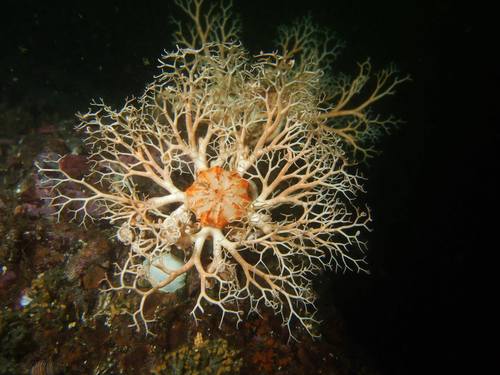
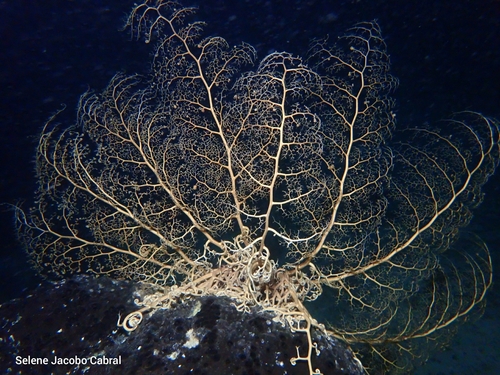
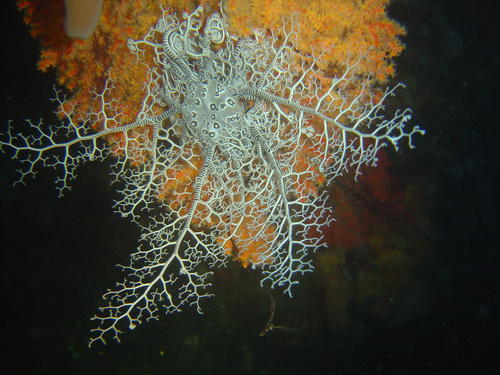
Astrocladus euryale has 10 arms that repeatedly branch in an alternating pattern into increasingly fine tendrils. These tendrils can extend to form a basket-shaped net for filter feeding, or roll up compactly against the body disc when the organism is not feeding. The body is typically pale grey, covered with whitish knobs that are usually ringed with black. Both the overall pattern and body color can vary across different regions. The arms are usually white to pale grey, marked with black stripes. The body disc can reach up to approximately 200 mm in diameter, and fully extended arms can grow up to 500 mm in length. When feeding, this species is often found on high points of reefs, or attached to sea fans, noble corals, or sponges. It inhabits reefs at depths ranging from around 10 m down to approximately 90 m. It was originally described as Asterias euryale by A. J. Retzius in 1783, published in Anmärkningar vid. Asteriae genus, within Kungliga Svenska Vetenskapsakademiens handlingar, Volume 4, pages 230–248.