About Astrocaryum vulgare Mart.
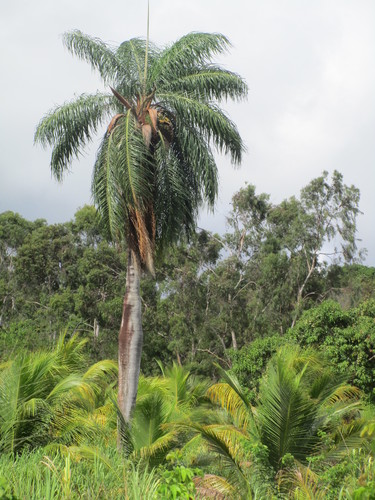
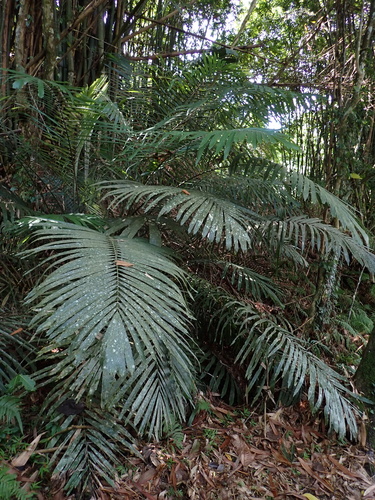
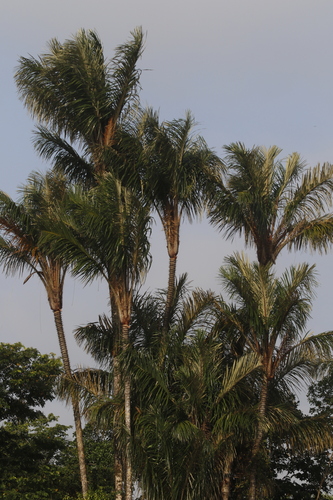
Astrocaryum vulgare Mart. is a palm tree that typically reaches 10–15 m (33–49 ft) in height, though it often grows shorter. It usually develops a few to many trunks of matching height and width, with each trunk growing 15–18 cm in diameter. Its multi-stemmed growth habit lets it regenerate easily after damage. The entire palm is covered in sharp spines: the trunk is densely covered with black, flattened spines of varying lengths that can grow up to 12 cm long, while the infructescence is covered in 1–3 cm long black spikes. Its spadices grow erect, and the inner spathe can reach 2 meters or more in length.
The fruit is an orange, round or nearly round drupe with a short pointed apex. It sits in a flat, cupule-shaped structure similar to an acorn cap, measuring about 1 by 2 cm, with a laciniate-crenulate margin. The fruit has oily, fibrous yellow or yellow-orange pulp; on average it weighs about 30 g (1 oz), and measures about 4.5 by 3–3.5 cm in size. It contains a large nut with a very hard, woody, almost black shell. The nut holds an oily white substance. The nut, also called a pyrene, is usually narrowed toward the base and contains one seed, though it may be globose if it holds two seeds. The shell is 3 mm thick.
This species is native to French Guiana, Guyana, Suriname, and the northern Amazonian region of Brazil. It is common in Pará state of Brazil and across the Guianas, very abundant in populated coastal areas, and extremely abundant in the white-sand savanna belt.
It is a characteristic palm of terra firme, rainforest that never becomes inundated, low vegetation areas, and open fields. Astrocaryum vulgare is considered a pioneer species with aggressive growth, and it can grow new shoots after fire. It mainly inhabits secondary forests and pastures, and is never found in undisturbed old-growth rainforest. In the Guianas it typically grows on rather dry, sandy soil, and is very common in white-sand savanna. Its seeds are probably dispersed mostly by capuchin monkeys and scatter-hoarding rodents including agoutis and achouchis. In Guyana, researchers have found its inflorescences produce heat and odor during nocturnal flowering, which attracts large groups of various beetles that feed, mate, and oviposit on them. While beetes do pollinate this palm, it also uses wind pollination, and experiments show it can also self-fertilize.
Seeds of this species can take up to two years to germinate, and plants grow slowly when cultivated. They begin producing fruit after eight years. Two different oils can be produced from the fruit: one from the external pulp, and one from the seed. External pulp makes up 34% of a fruit's total weight, and raw external pulp contains 14% to 16% oil. It has been theorized this species could be exploited in the future as an alternative to oil palm for biodiesel production. It is estimated that 400 palm clusters could be planted per hectare, with three trunks per cluster, for a total of 1200 trunks per hectare. A mature tree can produce up to 50 kg (110 lb) of fruit per year, which yields 2.5 kg (5.5 lb) of pulp oil and 1.5 kg (3.3 lb) of seed oil. Under ideal conditions, this could produce 4.8 tons of fatty material per hectare annually.