About Astreopora myriophthalma (Lamarck, 1816)
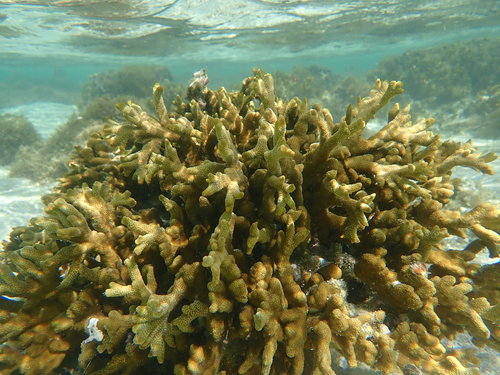
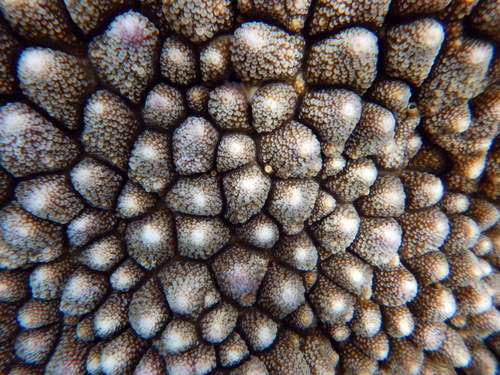
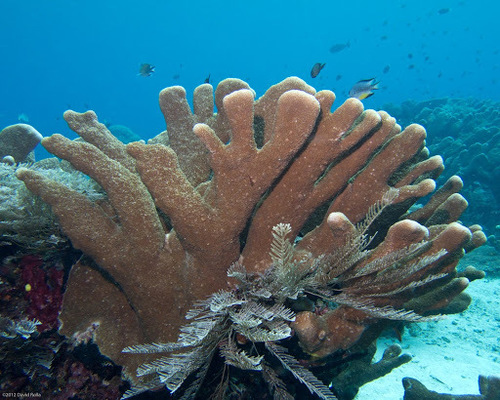
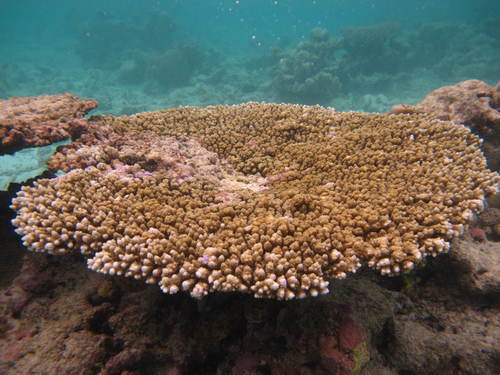
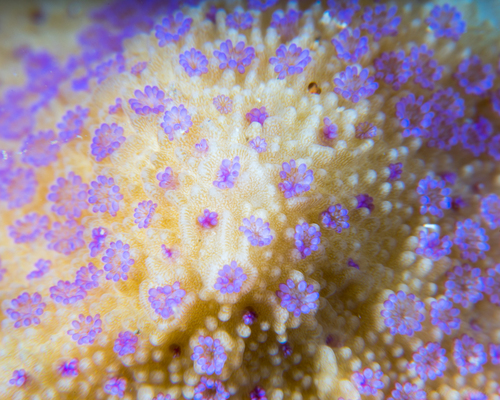
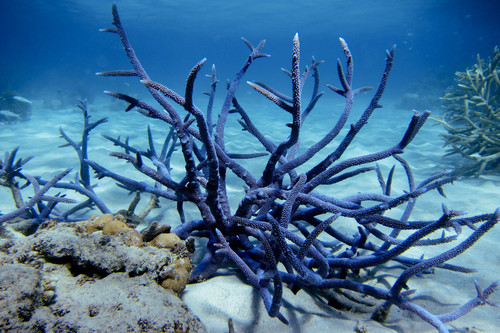
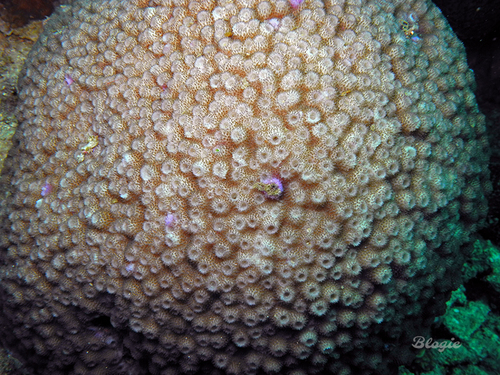
Astreopora myriophthalma is a colonial coral species that forms massive hemispherical or boulder-shaped colonies. Its corallites are conical, evenly distributed across the colony surface, and each has a circular opening that points upright or outward. The colour of this coral varies: it can be plain or mottled, and may appear cream, yellow, or brownish-blue. It is similar in appearance to Astreopora gracilis and Astreopora listeri.
This coral has a wide distribution across the tropical Indian and Pacific Oceans. Its range extends from East Africa and the Red Sea, through Indonesia and northern Australia, all the way to Japan, the Philippines, and various Pacific island groups. It occupies a variety of reef habitats at depths between 3 and 20 m (10 and 66 ft), but it avoids turbid water.
In terms of ecology, researchers have observed that when spionid worms bore into Astreopora myriophthalma, the coral tissue surrounding the worm colonies benefits. Researchers suggest that the worms' faeces provide extra nutrients for the coral's symbiotic zooxanthellae, and the increased photosynthetic activity of these algae leads to increased tissue growth in the surrounding coral. The bivalve Lithophaga simplex also bores into this coral, often living in dense populations. This is likely a symbiotic relationship: the bivalve benefits from protection and increased nutrition, and while the coral's structure is weakened by the boring, the coral benefits from ammonium excreted by the molluscs.