About Astrangia poculata (Ellis & Solander, 1786)
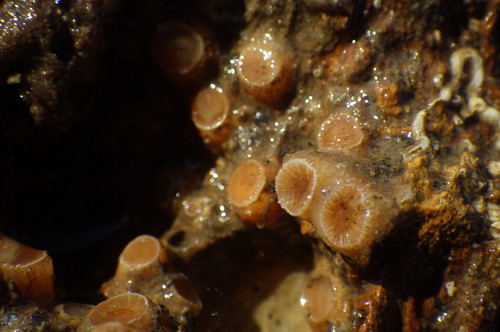
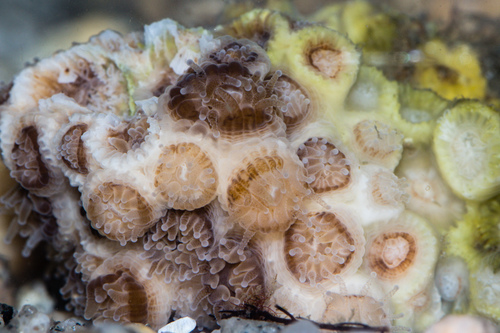
Astrangia poculata (Ellis & Solander, 1786) grows in small clumps up to 5 cm (2 in) across. Its individual large polyps sit in stony cups called corallites. The polyps are translucent, and the entire colony takes on a furry appearance when polyps are expanded. In warm water with high light levels, this coral typically hosts photosynthesizing symbiotic protists called zooxanthellae in its tissues, which gives the coral a brown appearance. In cooler water or low-light conditions, zooxanthellae may no longer benefit the coral and can be expelled, which leaves the coral pale in colour. It can be mistaken for the southern cup coral, Astrangia solitaria. A. solitaria has a more southerly distribution, is generally brown, may grow as a solitary individual, has larger corallites that are 4 mm (0.16 in) wide with 36 stony septa ridges, and never hosts zooxanthellae. Current researchers studying this coral use specific terms to describe its flexible symbiosis: Aposymbiotic refers to a host coral living functionally without symbionts, and corresponds to the white phenotype. This term is not to be confused with asymbiotic, which also produces a white phenotype but describes a coral that has absolutely zero symbionts, a true zero. Mixed symbiosis describes varying levels of symbiont presence across different polyps in a single colony, which results in a variable phenotype. Symbiotic describes a coral that is largely colonized by symbionts, corresponding to the brown phenotype. Astrangia poculata is native to the western Atlantic Ocean and Caribbean Sea, with a range that extends from Cape Cod, Massachusetts to the Gulf of Mexico. It also occurs along the western coast of Africa. It forms encrusting clumps on hard substrates, and is common under ledges and boulders, on pilings, and on shipwrecks. It also grows in deep water, and detached clumps sometimes wash up on shorelines.