About Astrangia haimei Verrill, 1866
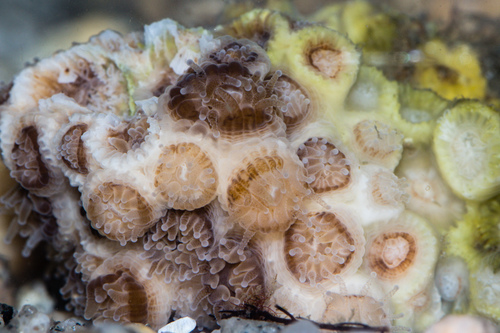
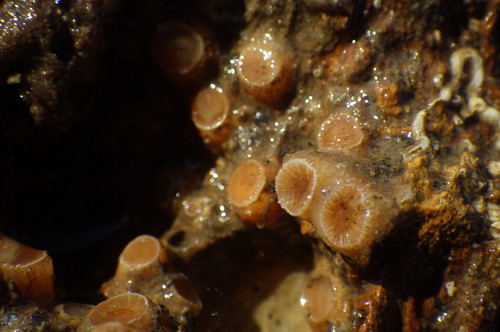
Astrangia haimei Verrill, 1866, commonly known as Haime's cup coral, is an aggregating coral that forms colonies made up of multiple small, corallite-secreting polyps. Individual polyps measure 2.5–3 mm (0.098–0.118 in) in diameter. Their corallites are cylindrical, typically 2–3.81 mm (0.079–0.150 in) tall, and each can extend more than 6.35 mm (0.250 in) above the basal mural expansion that connects all polyps in the colony. Corallites are spaced relatively far apart, with 1–6.35 mm (0.039–0.250 in) between adjacent individuals. The column and oral disc of the polyp are usually orange, though darker brown shades are also common. The tentacles are translucent, and each ends in a small white spherical tip. When a polyp withdraws its tentacles, the cup shape of the corallite and the simple, radiating ridges of its septa become clearly visible. This species is found in the Eastern Pacific Ocean. It is a relatively uncommon coral, most often observed along the coast from Monterey Bay, California, through the Baja California peninsula and the Gulf of California. Because the species was first described from specimens collected on the Pacific coast of Panama in 1866, its full total range is thought to extend much further south, possibly as far as Peru. Astrangia haimei lives at depths ranging from sea level down to at least 53 m (174 ft). It most commonly grows on vertical rock faces with moderate to high water flow. While it is typically a subtidal species, it can also be found in the low intertidal zone. Like other members of the family Rhizangiidae, Astrangia haimei reproduces via stolons. Like other polyp-forming cnidarians, Haime's cup coral is a sessile organism. It depends on underwater currents to bring plankton, its food source, within reach of its sticky, stinging tentacles.