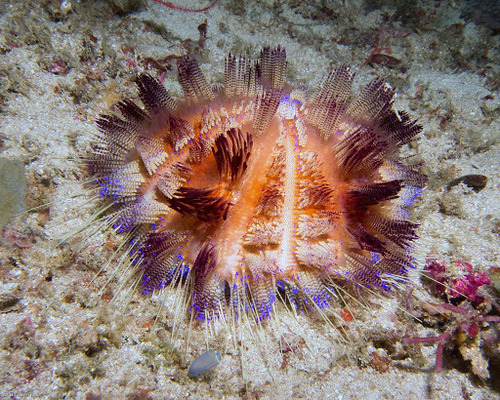
About Asthenosoma varium Grube, 1868
Asthenosoma varium is a large sea urchin with a hemispherical shape, reaching up to 25 cm (10 in) in diameter. Unlike most sea urchins, the plates that form its rigid internal test (skeleton) are not rigidly joined to each other. Instead, these plates are fused into groups of three: each group has one central primary plate, with a half-size plate on either side. Each group of plates overlaps the next group like roof tiles, making the entire test flexible. The test is split into five interambulacral areas, separated by five ambulacral grooves. It has two series of spines arranged in five radial bands; each spine connects to the test via a ball-and-socket joint. Primary spines on the aboral (upper) surface are short, thick, and sharply pointed. They grow in rectangular areas and are clustered into dense bundles. Each spine has multiple hollow, toxin-filled spherical capsules separated by narrow constrictions, and these capsules work like hypodermic syringes. On the oral (under) surface, primary spines have a different trumpet-shaped structure, with their shaft divided into four zones of different microstructure. This structure is similar to the spines of some Diadematidae, especially Echinothrix, and Toxopneustidae. Secondary spines are long, flexible, slender, and blunt, and are mostly found near the base of the test. They are used for locomotion and righting the urchin, and have sensory cells at their tips. The general body colour of this urchin can be orangish, red, brown, or purple; occasionally it is beige or some shade of green. Primary spines are banded, typically with paler bases and darker tips, while secondary spines are yellowish. This species is native to the Indo-Pacific region, with a range extending from the eastern Indian Ocean to Japan, the Philippines, and New Caledonia. Previous records of it occurring in the Red Sea most likely refer to the closely related species Asthenosoma marisrubri. It lives in coral environments at depths down to roughly 167 m (550 ft). Multiple organisms associate with this urchin, commonly called the Pacific fire urchin. These include the commensal shrimps Periclimenes colemani and Allopontonia brockii, the parasitic snail Leutzenia asthenosomae, and the zebra crab Zebrida adamsii. Siphamia tubifer, along with several other small fish, use the protection of this urchin's toxic spines, as do certain cephalopods. Asthenosoma varium is omnivorous. It feeds on the algal film that covers underwater substrates, encrusting invertebrates such as sponges and tunicates, and organic detritus. This species has separate sexes. Adults release gametes into the water column, where fertilization occurs. The larvae are planktonic, drifting for several months before settling onto the seabed, undergoing metamorphosis, and developing into juvenile sea urchins. The spines of Asthenosoma varium are venomous, and the urchin's bright colouration acts as a warning to other organisms of this danger. Divers should be cautious and avoid handling these urchins.

