About Asthenes pyrrholeuca (Vieillot, 1817)
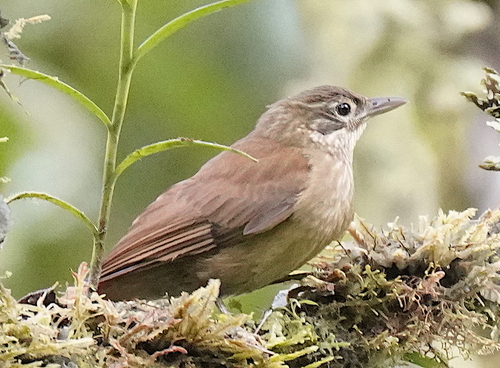
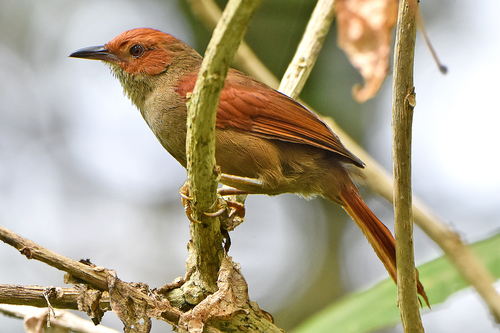
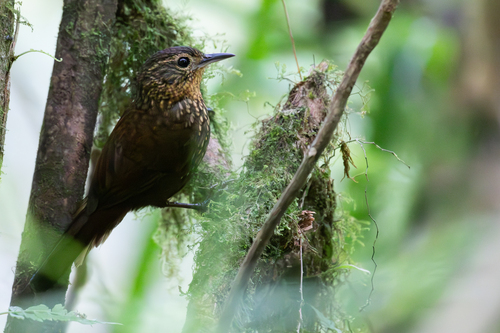
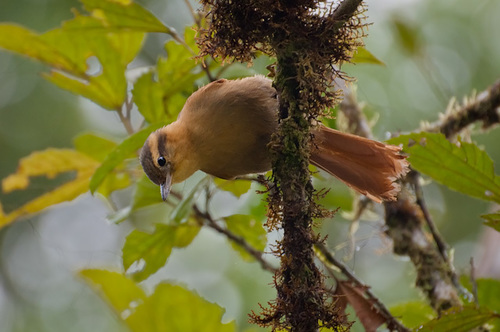
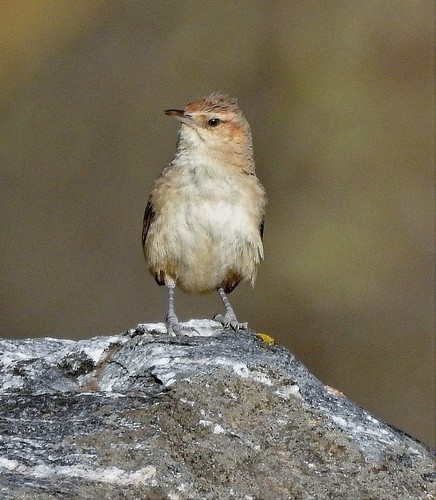
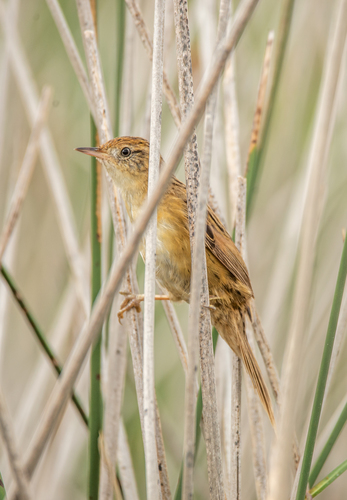
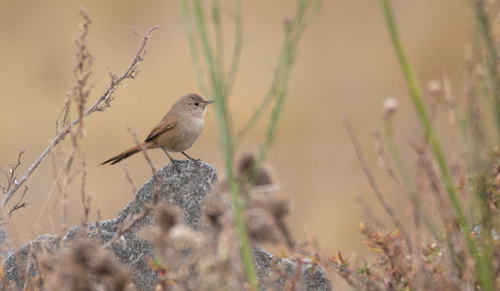
The sharp-billed canastero (Asthenes pyrrholeuca) is 14 to 15 cm (5.5 to 5.9 in) long and weighs 12 to 14 g (0.42 to 0.49 oz). It is one of the smaller canastero species, with a pointed bill that is thinner than the bills of most other canasteros. The sexes have identical plumage. Adults of the nominate subspecies have a gray-brown face with a paler supercilium. Their crown is dull brown, their back and rump are a slightly paler brown, and their long uppertail coverts are darker brown. Their wings are mostly dull rufescent brown. The central pair of their tail feathers are pointed; this pair and the next two pairs are dark fuscous brown with dusky tips, while the remaining tail feathers are mostly dull rufous with dark inner webs. Their chin and upper throat are rufous to tawny, marked with dark-tipped pale streaks. Their lower throat and breast are pale grayish brown, with faint streaks on the breast; their belly is pale buff-brown, and their flanks and undertail coverts are darker buff-brown with a rufescent tinge. Their iris is brown, their maxilla is slate-gray to black, their mandible is gray-horn, and their legs and feet are slate-gray. Juveniles lack the distinct throat patch and have mottled breast plumage. Subspecies A. p. sordida differs from the nominate subspecies only in having entirely rufous outer tail feathers. The nominate subspecies of the sharp-billed canastero breeds in central and southern Argentina, and migrates to northern Argentina, southern Paraguay, and Uruguay for the winter. Subspecies A. p. sordida breeds in central and southern Chile and west-central Argentina, and migrates to northern Argentina and southern Bolivia for the winter. The species inhabits a range of semi-arid to arid landscapes, including shrub-steppe, lowland and montane scrublands, and temperate, hilly, and rocky grasslands. During the non-breeding season, it also occurs in tall grass, marshy areas, and Gran Chaco scrub. Most of its range spans from sea level to 2,000 m (6,600 ft) in elevation, but it can be found locally as high as 3,000 m (9,800 ft).