About Asthenes modesta (Eyton, 1851)
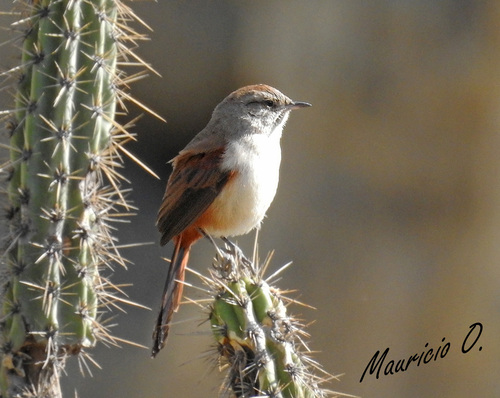
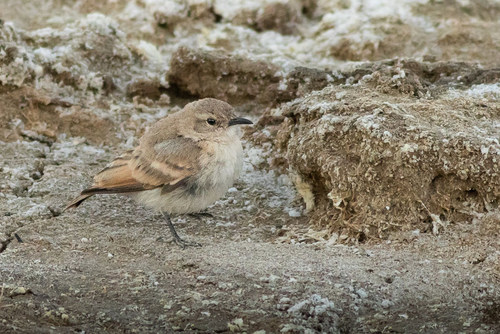
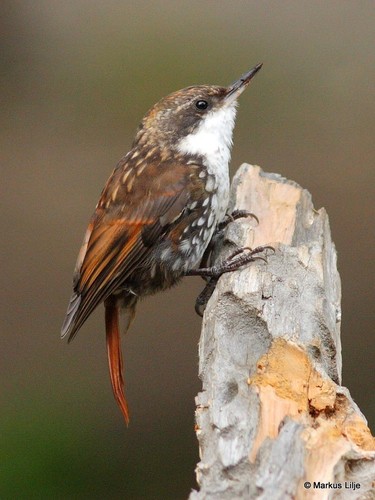
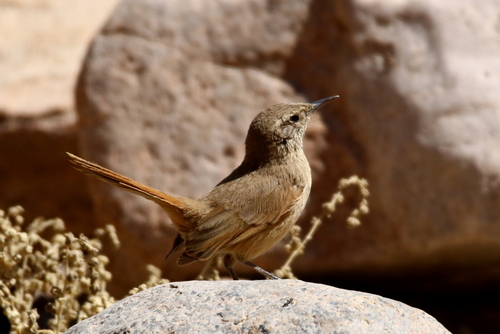
The cordilleran canastero (Asthenes modesta) is 15 to 16 cm (5.9 to 6.3 in) long and weighs 13 to 22 g (0.46 to 0.78 oz), and is one of the smaller canastero species. The sexes have identical plumage. Adults of the nominate subspecies A. m. modesta have a narrow light buff-brown supercilium, dark brownish lores, brownish ear coverts, and a whitish buff-brown malar region marked with darker brown streaks. Their entire upper body (crown, nape, back, rump, and uppertail coverts) is dull dark brown, though individuals in the southern part of the species' range have a paler, sandier back. Their forehead has indistinct blackish spots, and their rump and uppertail coverts carry a rufescent tinge. Their wing coverts are dark brownish with chestnut-rufous edges; the greater coverts are dark brownish with fulvous or tawny edges, and their flight feathers are dark fuscous with rufous bases. The central pair of their tail feathers are pointed and dark fuscous with rufous outer webs. The rest of the tail feathers have increasing amounts of rufous toward the outermost, which are almost entirely rufous. Their chin and upper throat are pale brownish with an orange-rufous patch at the center; their lower throat and upper breast are whitish gray-brown with darker streaks, their lower breast and belly are pale brown, and their flanks and undertail coverts are pale brown with a rufescent tinge. Their iris is brown to dark brown, their maxilla is black to dark brownish horn, their mandible is horn to brownish gray with a dark tip, and their legs and feet are blackish gray to dusky brown. Juveniles lack the orange-rufous throat patch, and their breast and belly are mottled. The other described subspecies differ from the nominate and each other in the following ways: A. m. proxima has a darker back than the nominate, and has tawny-rufous rather than intense rufous coloring on the tail feathers. A. m. rostrata has darker upperparts and darker central tail feathers than the nominate, and darker rufous coloring in the wings. A. m. hilereti has a grayer back than both the nominate and A. m. rostrata. A. m. serrana has paler, grayer underparts than the nominate, with an added ochraceous tinge. A. m. cordobae has darker, less cinnamon upperparts and less cinnamon underparts than the nominate, and has the darkest wings and tail of all subspecies. A. m. australis has grayer upperparts and paler, less buffy underparts than the nominate, with less rufescent wing coverts. Different subspecies of cordilleran canastero occupy separate geographic ranges: A. m. proxima is found in the Andes of central and southern Peru, from the Department of Junín to the Department of Cuzco. A. m. modesta ranges across the Andes of southwestern Peru and western Bolivia, extending south into northern Chile and northwestern Argentina. A. m. hilereti occurs in Tucumán and Catamarca provinces in northwestern Argentina. A. m. rostrata is found on the eastern slope of the Andes in the central Bolivian departments of La Paz and Cochabamba. A. m. serrana is restricted to Sierra de Famatina in western Argentina's La Rioja Province. A. m. cordobae is found in central Argentina. A. m. australis occurs in the Andes and lowlands of central and southern Chile, and western and southern Argentina. The cordilleran canastero primarily inhabits puna, temperate, and arid to semi-humid grasslands, most often those with rocky outcrops and scattered small bushes. It can also be found in arid montane scrublands, Polylepis thickets, and dry open woodlands. Its elevation range extends from near sea level up to 4,500 m (14,800 ft).