About Asthenes flammulata (Jardine, 1850)
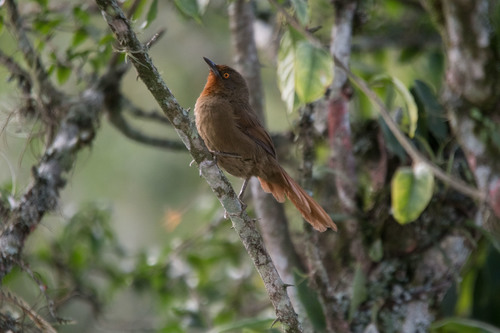
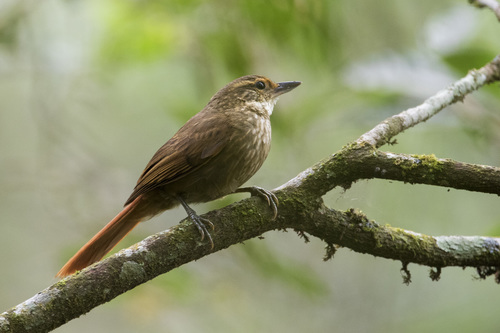
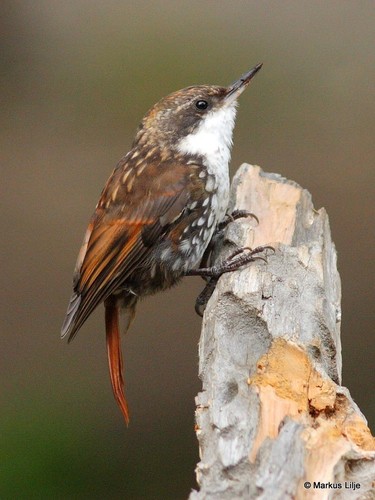
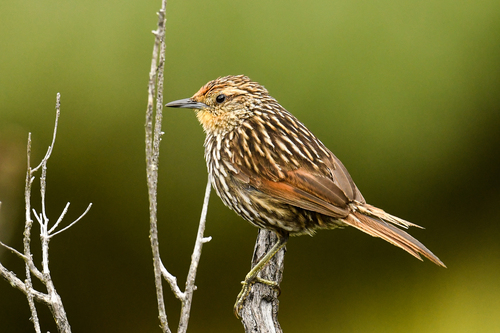
The many-striped canastero (Asthenes flammulata) measures 16 to 17 cm (6.3 to 6.7 in) in length and weighs 17 to 27 g (0.60 to 0.95 oz). It is a large canastero, and the most dramatically striped species in the genus. The sexes have identical plumage. Adults of the nominate subspecies have a buff-whitish supercilium on an otherwise dark brownish face marked with buff to whitish streaks. Their forehead is bright tawny-brown or rufescent brown, with dark brown stripes that widen to form the brown crown with rufescent streaks. Their upperparts, from the back to the uppertail coverts, are dark brown with conspicuous pale buff streaks. Their wing coverts are dark brown with rufous edges, and their flight feathers are reddish-rufous with dark fuscous tips. Their tail feathers have dark brown inner webs and rufous outer webs; they are narrow, giving the tail a spiny appearance. Their chin and upper throat are orange-buff to orange-rufous, which fades and becomes duller on the lower throat. Their breast and flanks are whitish with bold dark brown streaks, which become paler and less bold on the whitish belly. Their lower flanks and undertail coverts are rufescent brown with indistinct pale streaks. Their iris is brown to dark brown, their maxilla is black to dark horn, their mandible is black to dark brownish with a blue-gray to gray base, and their legs and feet are brown to olive to greenish gray. Juveniles have a fainter throat patch and less distinct streaks than adults. Subspecies A. f. multostriata differs from the nominate by having a more ochraceous supercilium, a darker chestnut forehead, a deeper rufous chin and throat, and wider blackish edges on the streaks of the flanks and undertail coverts. A. f. quindiana is similar to multostriata, but has a white chin, a paler throat, and narrower streaks on the undertail coverts. A. f. taczanowskii has a pale buff to off-white throat and narrower streaks on the back than the nominate. Its underpart streaks are confined to the breast and flanks; the middle of the breast, belly, and undertail coverts are unmarked grayish white. A. f. pallida is similar to taczanowskii, but has somewhat wider streaks on the back and a buff-ochraceous wash on the throat and neck. The many-striped canastero may be confused with the similar streak-backed canastero (A. wyatti), which is much less heavily marked overall. It also resembles the distantly related Andean tit-spinetail (Leptasthenura andicola). The ranges of all three species overlap in some areas. The many-striped canastero has a disjunct distribution across the Andes of northwestern South America. The five recognized subspecies are distributed as follows: A. f. multostriata is found in Colombia's Eastern Andes, between the departments of Norte de Santander and Cundinamarca; A. f. quindiana is found in Colombia's Central Andes, between the departments of Caldas and Cauca; A. f. flammulata (the nominate subspecies) ranges from Nariño Department in Colombia's Western Andes south through the Ecuadorian Andes, just into the Department of Cajamarca in northern Peru; A. f. pallida occurs in the Andes of northern Peru's Cajamarca and La Libertad departments; A. f. taczanowskii is found in the Andes of northern and central Peru, from southern Amazonas and Cajamarca departments south to Ancash and Junín departments. The many-striped canastero inhabits the ecotone between timberline and páramo grasslands, a landscape defined by rock outcrops, scattered shrubs, Espeletia, and groves of Polylepis trees. It mostly occurs at elevations between 3,000 and 4,500 m (9,800 and 14,800 ft), but can be found as low as 2,700 m (8,900 ft) in Colombia.