About Asthenes dorbignyi (Reichenbach, 1853)
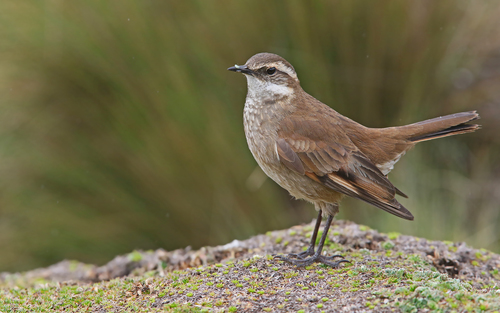
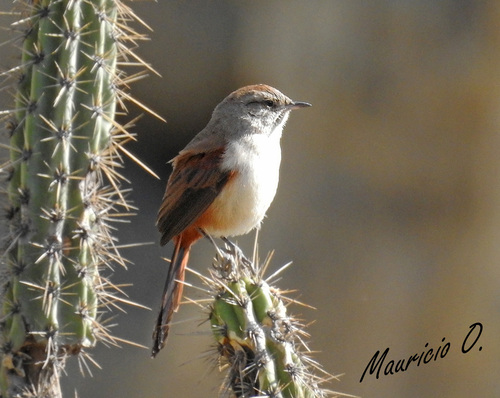
The rusty-vented canastero (Asthenes dorbignyi) is a medium-sized canastero, measuring 14.5 to 16.5 cm (5.7 to 6.5 in) in length and weighing 17.5 to 24 g (0.62 to 0.85 oz). Males and females have identical plumage patterns. For adults of the nominate subspecies, the face is mostly dull buff, with a light gray supercilium and an indistinct brownish line behind the eye. Their crown, nape, and back are pale brown, while their rump and uppertail coverts are rufous brown. Their wing coverts are rufous chestnut, and their flight feathers are dusky; the inner flight feathers have wide rufous chestnut edges. The outermost pair of tail feathers are rufous, and all other tail feathers are blackish. The center of the throat is orange rufous. The sides of the throat, breast, and belly are creamy white, the flanks are tawny rufous, and the undertail coverts are rufous. Their iris ranges from dark brown to light gray, their maxilla is black or dark gray, their mandible is blackish and often has a pinkish base, and their legs and feet range from blue-gray to black. Juveniles have an entirely white throat, with faint dusky bars or mottling on the breast and belly. Subspecies A. d. consobrina is very similar to the nominate subspecies, but its primaries are entirely dark, which creates a contrast with the chestnut color of its secondaries. The nominate subspecies of the rusty-vented canastero is distributed in the Andes, from Cochabamba Department in central Bolivia south to northwestern Argentina as far as Mendoza Province. Subspecies A. d. consobrina occurs in the Andes of the La Paz, Oruro, and Potosí departments of southwestern Bolivia. This species lives in arid landscapes, most commonly in scrublands and adjacent woodlands.