About Asthenes anthoides (King, 1831)
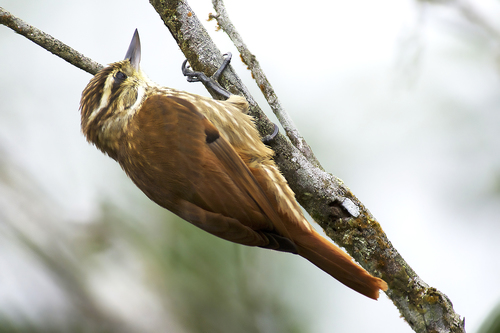
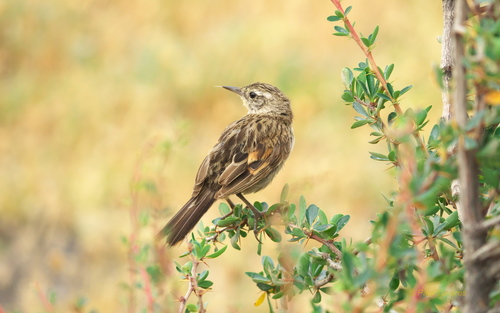
The austral canastero (Asthenes anthoides) measures 15.5 to 16.5 cm (6.1 to 6.5 in) in length and weighs 21 to 23 g (0.74 to 0.81 oz). It is the southernmost member of the canastero group, and is one of several streaked canastero species that have drab plumage marked with dark stripes on the upperparts. It has a shorter tail than most other canasteros. The sexes have identical plumage, but there is extensive individual variation. Adults have a whitish or pale buff supercilium and dark dusky lores on an otherwise sandy brown face. Their crown, back, and rump are sandy brown with prominent blackish streaks. Their wings are brownish, with cinnamon to brown coverts and dark dusky flight feathers that have pale tawny brown bases on the primaries. The central pair of tail feathers are dark olive-brown with a dark brown streak along the shaft; the next pair are mostly dusky, and the remaining feathers are mostly dusky with whitish ochre tips. Their chin is whitish, and sometimes has a pale orange-rufous patch. Their throat, breast, and belly are whitish or very pale sandy brown, with some blackish streaks on the sides of the breast and the flanks. Their iris is black, their bill is black with a whitish base to the mandible, and their legs and feet range from pink to dusky gray. Juveniles have blackish-brown streaks on their breast and sides. The austral canastero has a disjunct distribution. In Chile, it occurs from the Coquimbo Region south into the Aysén Region, and from the mainland southern Magallanes Region onto Tierra del Fuego. In Argentina, it occurs from Neuquén Province south into Chubut Province, and from southern Santa Cruz Province onto Tierra del Fuego. It primarily lives in mesic shrub-steppe defined by moderately tall shrubs and tussock grass. It is also found in more open scrublands with less tussock grass and Nothofagus woodlands. It avoids grasslands that have no shrubs or trees. In elevation, it mostly occurs between sea level and about 200 m (700 ft), but there are occasional records of individuals as high as 1,750 m (5,700 ft).