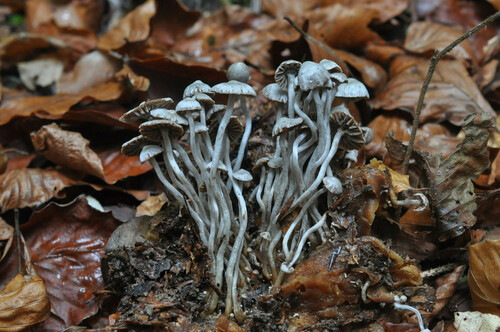
About Asterophora parasitica (Bull.) Singer
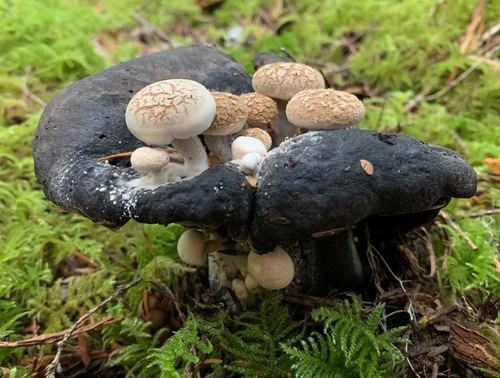
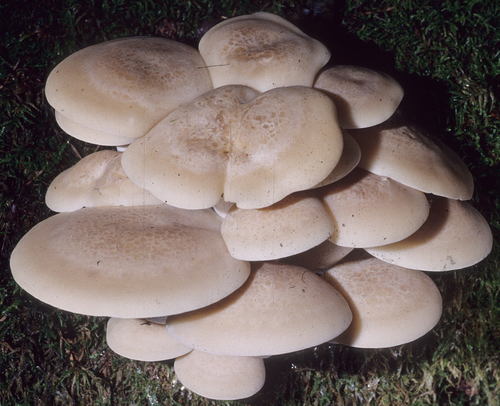
The cap of Asterophora parasitica is initially round to convex, then flattens as it matures, reaching a diameter of 8–20 mm (0.3–0.8 in). Young fruit bodies have a smooth cap surface covered in smooth fibrils. The cap is white to pale grey when young, turning grayish brown at maturity, and its margin is initially rolled inward. The flesh is thin, whitish to brownish in color, has an unpleasant odor, and a farinaceous (mealy) taste. The gills are thick, widely spaced, attach to the stem in an attached to somewhat decurrent arrangement, and are whitish to grayish brown. They are often poorly developed, sometimes forked near the cap margin, and their edges are covered with fine granules. The stipe (stem) is 1–3 cm (0.4–1.2 in) long and 2–3 mm (0.08–0.12 in) thick, with a surface of fine white fibers over a grayish brown background. The base of the cap is sometimes finely velvety and white, and the stipe is initially solid before becoming hollow as it ages. Asterophora parasitica produces a white spore print. Its edibility is unknown. Basidiospores are elliptical, smooth, hyaline (translucent), and measure 5–6 by 3–4 μm. Chlamydospores produced by the gills are spindle-shaped to oval, usually thick-walled, and measure 12–17 by 9–10 μm. Fruit bodies of Asterophora parasitica grow in groups or clusters on decomposing mushrooms of Lactarius and Russula species, particularly those in the Russula nigricans group. It has been recorded in Europe and North America. While it is not uncommon in southern and central Europe, it is rare in Scandinavia, where it does not grow outside the northern range limit of Quercus (oak) species. This distribution pattern suggests that the properties of soil where host mushrooms grow can affect how suitable the hosts are as a substrate for A. parasitica. It takes approximately three weeks for A. parasitica to finish its development on a host agaric. The tremelloid yeast Asterotremella albida, which has cup-shaped parenthesomes, has been isolated from the gill tissue of A. parasitica; this yeast is also found on the related species Asterophora lycoperdoides. Much of what is known about the life cycle of Asterophora parasitica was first detailed by German mycologist Julius Oscar Brefeld, who successfully germinated both basidiospores and chlamydospores of the species.