About Asterophora lycoperdoides (Bull.) Ditmar
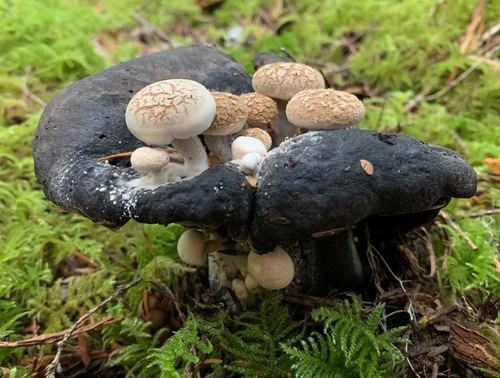
The cap of Asterophora lycoperdoides is initially white, but quickly becomes covered in brown powder, and can grow up to 2 centimetres (3⁄4 in) wide. Its gills are adnate, fairly widely spaced, and sometimes forked. The stems reach up to 5 cm (2 in) in length. Asexual spores called chlamydospores are produced on the mushroom's cap; these spores allow the organism to clone itself easily. The chlamydospores are star-shaped, which gives the species its genus name meaning 'star bearer'. This species is classified as nonpoisonous, but is not considered edible. It is similar to Asterophora parasitica, but that species has more conical caps, typically more developed gills, and fusiform rather than star-shaped chlamydospores. Asterophora lycoperdoides grows as a parasite on other mushrooms, most commonly species of the genus Russula. In eastern North America, it can be found from July to September, while it appears somewhat later on the West Coast of North America. In temperate Europe, it occurs from August to November, and can be locally common.