About Asterias rubens Linnaeus, 1758
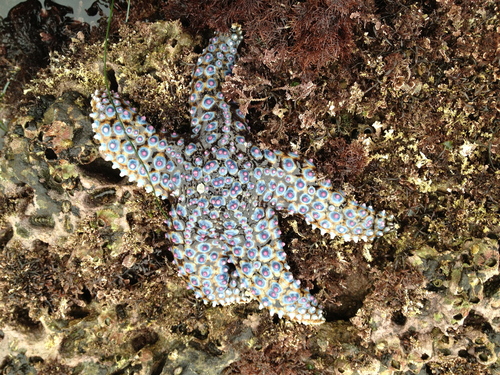
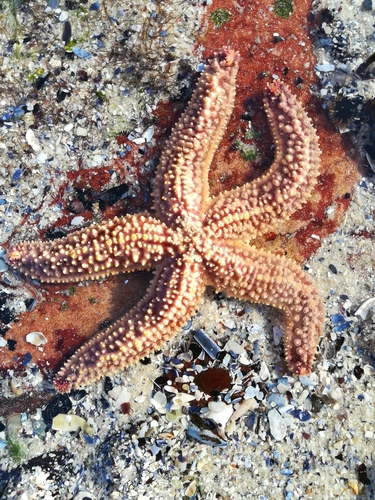
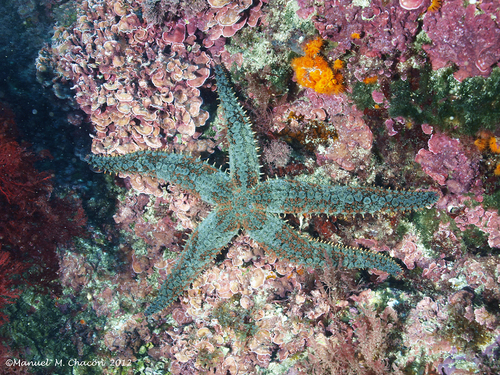
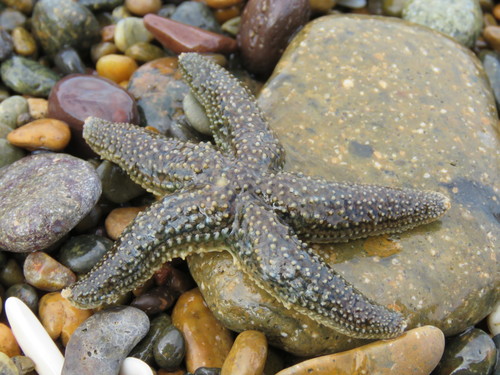
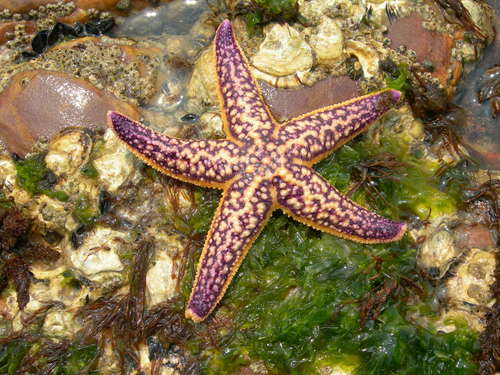
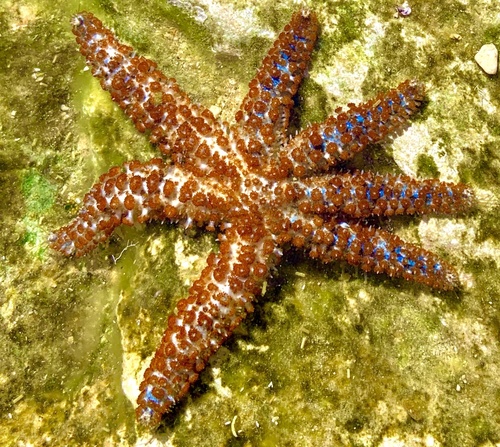
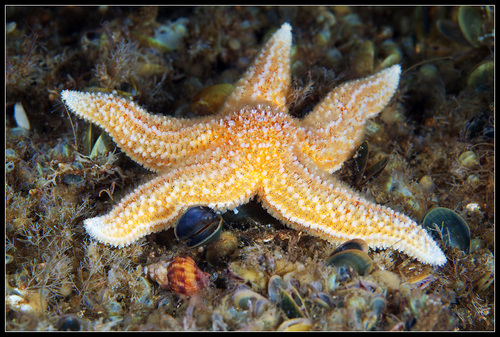
Asterias rubens, the common starfish, is scientifically named Asterias rubens Linnaeus, 1758. This species normally has five arms that are broad at the base and gradually taper to slightly upturned pointed tips. A line of short white spines runs along the center of the aboral (upper) surface of each arm, with low soft mounds called papulae on either side of the spine line. The oral (lower) surfaces of the arms bear rows of small tube feet, which the starfish uses for locomotion and feeding. Most common starfish have an orange or brick red aboral surface and a paler oral surface, but they can also be purple or pale brown. Individuals living in deep water are usually paler than shallow water specimens. This species reaches a maximum diameter of around 52 centimeters (20 inches), but most adults measure 10 to 30 cm (4 to 12 inches) across. The common starfish is native to the northeastern Atlantic Ocean, with a range stretching from Norway and Sweden through the North Sea, around the coasts of Britain, France, Spain and Portugal, and south along African coasts to Senegal. It is mostly absent from the Mediterranean Sea. It also occurs in the western Atlantic, where it can be found between Labrador and Florida, as well as in the Gulf of Mexico. It can survive in brackish water. The common starfish feeds on a range of benthic organisms, including bivalve molluscs, polychaete worms, barnacles, gastropod molluscs, other echinoderms, and carrion. When feeding on a mollusc such as a mussel, it attaches its tube feet to each shell valve and pulls to create a small gap. Even a 1 mm (0.04 in) gap is enough for the starfish to insert a fold of its stomach, secrete digestive enzymes, and begin digesting the mollusc's body. Once the contents are sufficiently liquid, the starfish retracts its stomach back into its body with the food inside. The common starfish has a well-developed sense of smell. It can detect the odor of prey such as the common mussel Mytilus edulis and crawl toward it, and it can also detect the odor of the predatory common sunstar Crossaster papposus— which eats other starfish— and take evasive action. Common starfish are dioecious, meaning each individual is either male or female. In spring, females release their eggs into the water, and a moderate-sized individual is estimated to produce up to 2.5 million eggs. Males release sperm into the water, and fertilization occurs in the open water column. The resulting larvae are planktonic, drifting for around 87 days before settling on the seabed and metamorphosing into juvenile starfish. Common starfish are thought to have a lifespan of around seven to eight years. When well fed, juvenile common starfish increase their radius by slightly more than 10 mm (0.4 in) per month during summer and autumn, and by slightly less than 5 millimeters (0.20 in) per month during winter. Adult common starfish can survive starvation for several months, though they lose weight during this time; one recorded specimen shrank from a 6 centimeter (2.4 in) radius to a 3.8 centimeter (1.5 in) radius after five months of starvation. The ciliate protozoan Orchitophrya stellarum is sometimes a parasite of the common starfish. It normally lives on the starfish's outer surface and feeds on sloughed-off epidermal tissue, and only becomes parasitic when it encounters a male host starfish with ripe gonads. It enters the starfish through the gonopores, the openings where gametes are released. A pheromone from ripe testes may alert the ciliate and trigger this change in behavior. Because different starfish species breed at different times of year, Orchitophrya stellarum can move between host species to match their reproductive cycles. In the Atlantic Ocean, it may alternate between parasitizing Asterias forbesi and Asterias rubens during spring and summer, and may use Leptasterias spp. as winter hosts. The ciliate has been found in the testes of all these species. When inside the gonad, it phagocytoses the sperm, leaving the infected starfish infertile. Researchers have recorded shifted sex ratios in affected populations, with fewer males than females, and infected males are consistently smaller than females. The common starfish produces a saponin-like substance that repels predators. This substance causes a reaction in the common whelk Buccinum undatum: at dilute concentrations, it triggers the whelk to take evasive action, and at higher concentrations, it causes a series of convulsions.