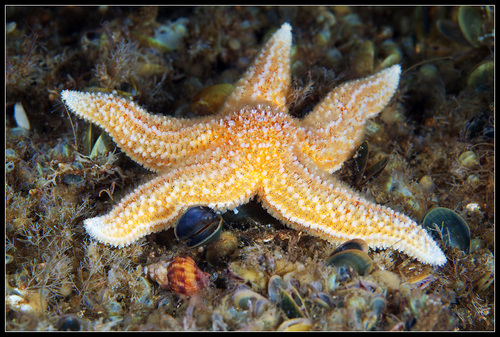
About Asterias forbesi (Desor, 1848)
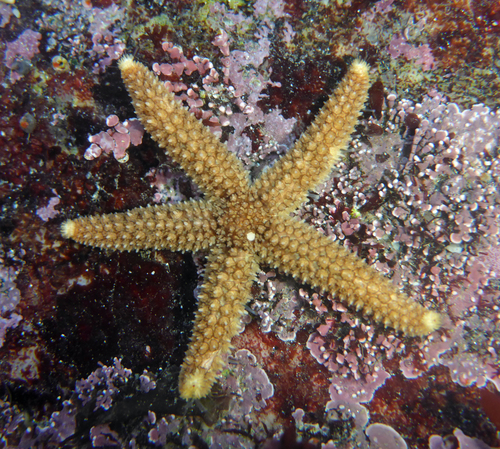
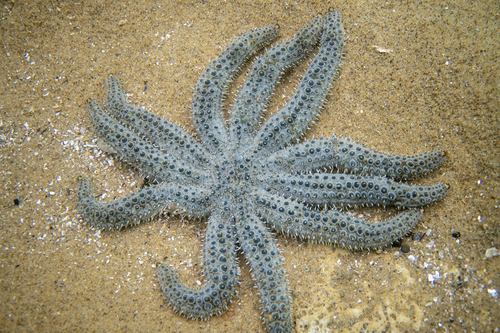
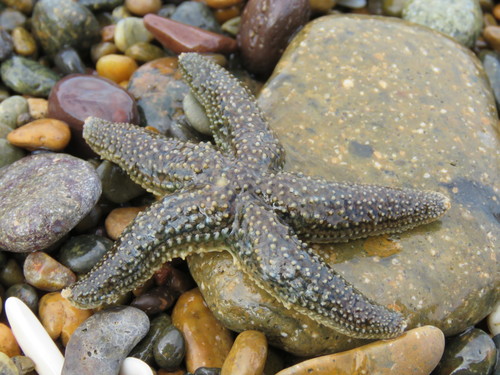
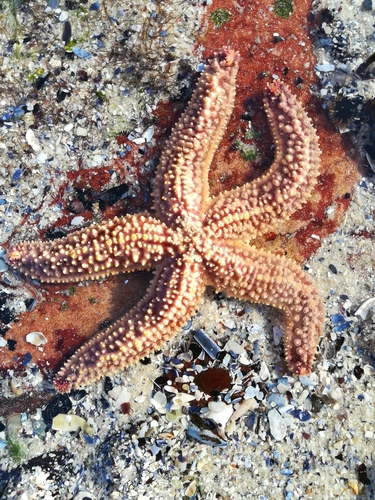
Asterias forbesi usually has 5 arms, though it occasionally has 4 or 6. Like many starfish species, its upper surface is covered in blunt conical projections that give it a rough texture. Some of these projections are pedicellariae: minute pincers that can grip objects. Its arms are plump, broad at the base, and taper to a blunt tip. This starfish reaches a diameter of about 15 centimetres (5.9 inches), with an arm length of approximately 6 centimetres (2.4 inches). Its madreporite is usually pink and visible near the edge of the central disc. On the underside of each arm, several rows of tube feet run along either side of the ambulacral groove that extends down the arm's center. The color of the starfish's upper side is variable, ranging from brown or tan to reddish-purple, while its underside is usually pale brown. Small eyespots are located near the tip on the underside of each arm. Unlike the otherwise similar Asterias rubens, a species that is often confused with Asterias forbesi, these eyespots are not set on short stalks. Asterias forbesi inhabits the intertidal zone of rocky shores along the Atlantic coast of North America, ranging from Maine south to the Gulf of Mexico. This rocky habitat benefits the species because it helps prevent individuals from being washed away by ocean waves. In comparison, Asterias rubens has a more northerly range, found from Labrador south to Cape Hatteras, and is most common north of Cape Cod in colder, deeper waters. The ciliate parasite Orchitophrya stellarum has been found in the gonads of up to 20% of male Asterias forbesi in Long Island Sound. These parasites feed on gonad tissue and effectively castrate their host. A small number of female Asterias forbesi have also been found carrying the parasite.