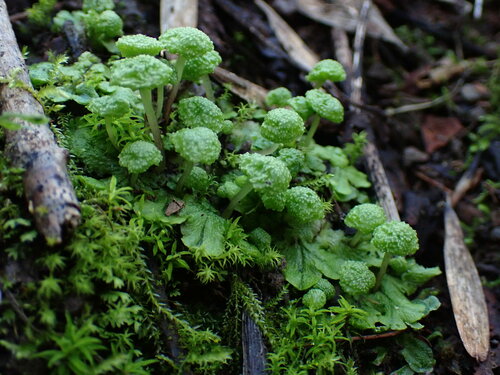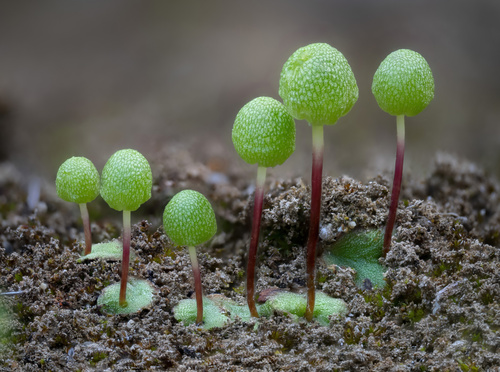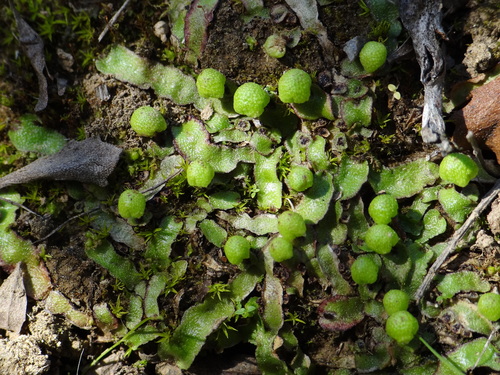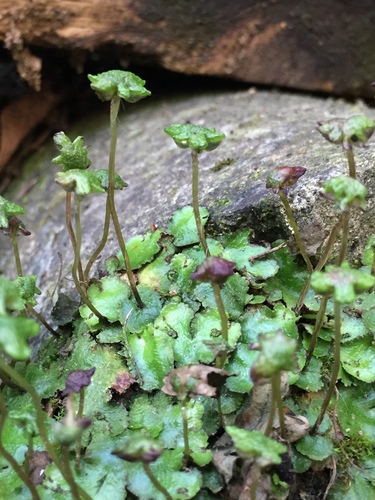
About Asterella californica (Hampe ex Austin) Underw.
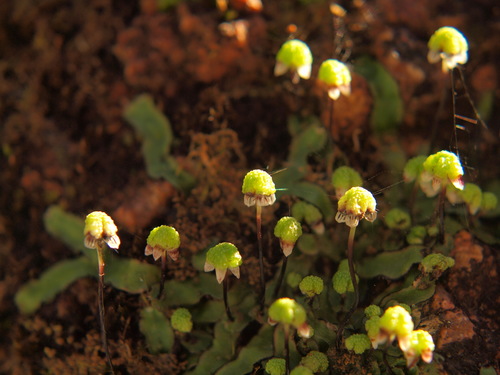
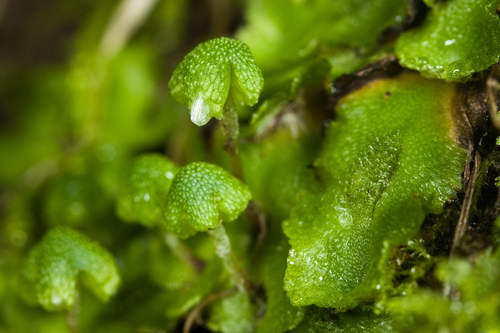
The dorsal surface of Asterella californica plants is pale green, with ascending purple margins and a dark purple underside. When conditions are dry, thallus edges tend to curl upward, exposing the dark underside. The thalli are either simple or have only sparse dichotomous branching, measuring 8–25 mm in length, and typically branch dichotomously 1 to 3 times. The ultimate segments are emarginated, shaped obovate, obcordate, or broadly oblong, are indistinctly areolate, and reach a maximum width of 4–12 mm. The plants dry out completely during long rainless summers, but the branch tips remain alive, so each growing tip becomes the starting point for a new individual. A surprisingly large portion of the thallus stays alive through the dry period; within a few hours after dried plants receive water, the forward section of the thallus returns to an active state and resumes growth. In this species, the first antheridia reach maturity in approximately two weeks. This early development of reproductive organs prompted the question of whether antheridia might begin developing before the end of the spring growing period. Asterella californica is widespread and common on lightly shaded slopes, banks, and areas surrounding rock outcrops. It grows most often in oak forest and chaparral within desert scrub, occurring mostly below 3000 feet in elevation, though it can grow up to 7000 feet in San Bernardino County. This species can be found throughout the Coast Ranges, western Klamath Ranges, Sacramento Valley, west slope of the Sierra Nevada, coastal Southern California, the Channel Islands, Transverse Ranges, Peninsular Ranges, and western Colorado Desert. Its range extends east to Arizona, north to southwestern Oregon, and south to northern Baja California. It grows on mineral soil, or among rocks on mineral soil, on open or lightly shaded banks.