About Asplenium trichomanes L.
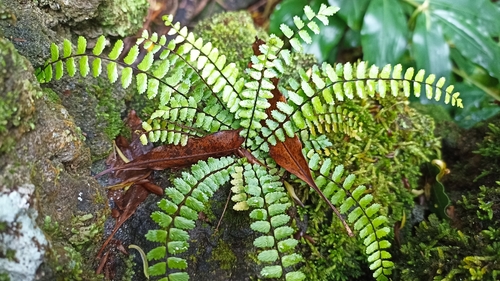
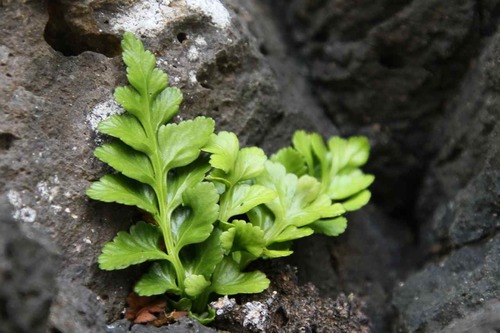
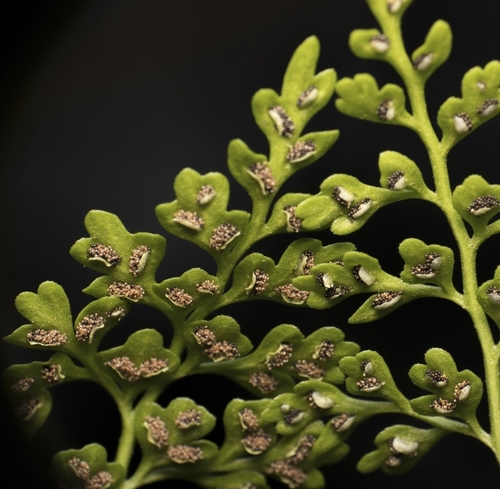
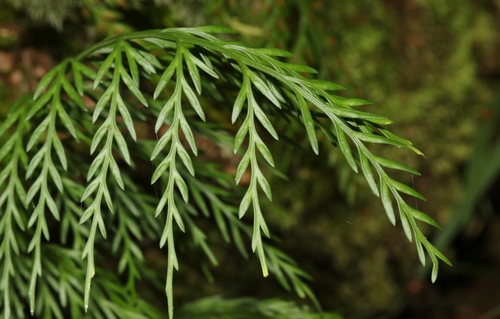
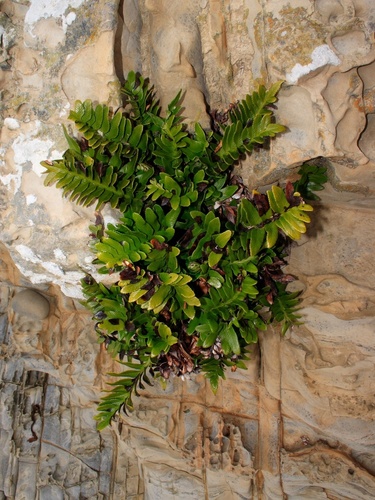
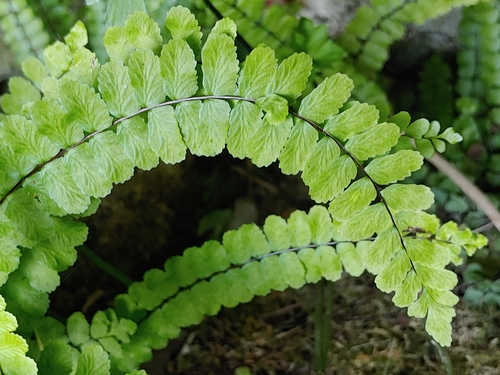
Asplenium trichomanes L. is a small fern that grows in tufts 10 to 30 cm (3.9 to 11.8 in) tall, growing from a short, scaly rhizome. Its rhizome scales are dark, and its evergreen fronds are long and narrow, gradually tapering toward the tip. Fronds are simply divided into small, yellow-green to dark-green, roundish leaflets called pinnae. The stipe and rachis of the frond are dark along their entire length. Fronds can reach 40 cm (16 in) in length, but are more commonly between 8 and 20 cm (3.1 and 7.9 in) long. Its indusia are linear to oval, straight, and attached to the upper side of the fertile vein. There are usually four to eight sori per pinna, and each sorus can be up to 3.5 mm (0.14 in) long. The diploid (2n) chromosome count of this species is 72. It is known to exhibit foliage movement, similar in this trait to the unrelated Codariocalyx motorius, though Codariocalyx motorius has moving leaflets most of the time. This species is widespread across temperate and subarctic regions, and also grows in mountainous areas of the tropics. Its range covers most of Europe and much of Asia, extending south to Turkey, Iran and the Himalayas, with an additional population in Yemen. It grows in northern, southern and parts of eastern Africa, as well as eastern Indonesia, south-east Australia, Tasmania, New Zealand and Hawaii. It is also found in North America, Central America, Cuba, and the northern and western regions of South America including Chile. Despite its broad overall range, it is often rare, and its populations are widely spaced depending on the availability of suitable habitat. It grows in rocky habitats including cliffs, scree slopes, walls and mine waste, and the specific rock substrate it grows on varies by subspecies. It grows from sea level up to 3000 metres in North America, while it reaches 870 metres in elevation in the British Isles. In the U.S. state of Minnesota, A. trichomanes is listed as a threatened species. Minnesota populations grow on ledges and in crevices of moist, east-facing cliffs, and occasionally on talus slopes with similar conditions. All Minnesota populations belong to Asplenium trichomanes subsp. trichomanes. In cultivation, Asplenium trichomanes is valued for its hardiness (surviving temperatures down to −20 °C (−4 °F)), its evergreen foliage, and its ability to colonise crevices in stone walls. It prefers a fully or partially shaded growing position. It has been awarded the Royal Horticultural Society's Award of Garden Merit.