About Asplenium septentrionale (L.) Hoffm.
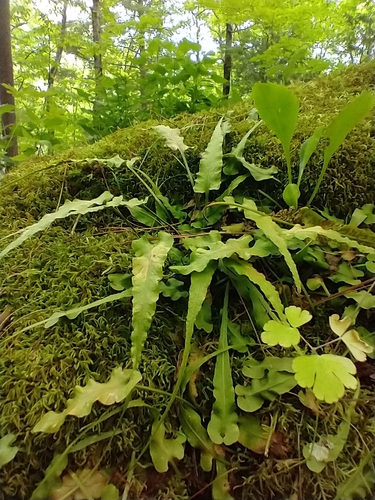
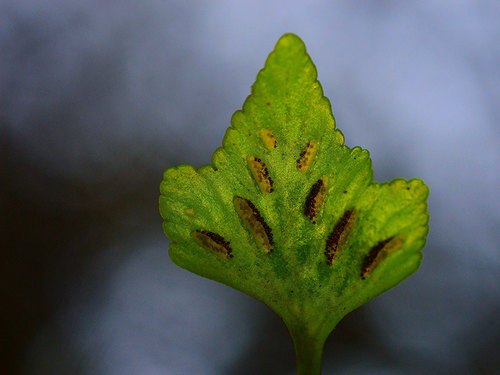
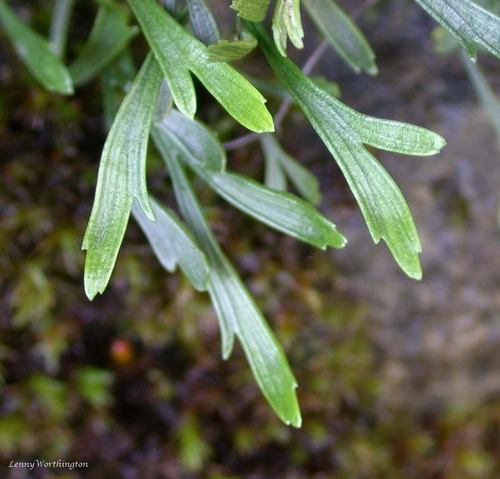
Asplenium septentrionale (L.) Hoffm. is a small fern that grows in dense clusters that superficially resemble tufts of grass. Long, dark stems support narrow, leathery leaf blades, which may appear slightly forked at the tip. This species produces monomorphic fronds, meaning fertile and sterile fronds do not differ in shape or size. The rhizome, which produces all of a single plant’s many leaves, is about 1 millimetre in diameter, and covered with scales. These scales are narrowly triangular, ranging in color from black to dark reddish brown. They measure 2 to 4 millimetres (0.08 to 0.2 in) long and 0.3 to 0.6 millimetres wide, with entire, untoothed edges. The stipes (the leaf stalk below the blade) are reddish brown at the base, fading to green further up. They range from 2 to 13 centimetres (0.8 to 5 in) in length, and are typically 2 to 5 times the length of the leaf blade itself. The leaf blades are narrow with parallel edges following the stem, ranging from 0.5 to 4 centimetres (0.2 to 2 in) in length and 0.1 to 0.4 centimetres (0.04 to 0.2 in) in width. They taper to a point at both the base and tip, and have a leathery texture. Leaf blades are often divided into pinnae (leaflets) near the tip, usually two, but sometimes four. These pinnae angle sharply toward the blade tip, giving the blade a forked appearance. They also taper to a point at the tip, and have a few widely spaced, irregular teeth. The rachis, the central leaf axis, is green and shiny. All parts of the leaf, including the rachis, have no hairs or scales. Fertile and sterile fronds have identical appearance. In fertile fronds, the sori are linear, and positioned parallel to the edges of each pinna, with usually two or more sori per pinna. The sori are covered by thin, pale tan indusia with entire edges. Each sporangium holds 64 spores, and most sporophytes have a chromosome number of 2n=144, which is tetraploid. Individual plants produce many leaves, forming dense tufts growing from a rhizome of about 1 millimetre in diameter, and sometimes form mats on flat rocks. A. septentrionale is easily distinguished from other related ferns by its narrow blades, which are often forked at the tip. The presence of sori on fertile leaves distinguishes it from the vegetative growth of grasses or sedges. Regarding distribution and habitat, Asplenium septentrionale subsp. septentrionale occurs in Europe and Asia, ranging from the Macaronesian Islands east through Europe, western Asia, the former USSR, northern India, and parts of western and central China (Xinjiang, Tibet, and Shaanxi), as well as Taiwan. It is also found in North America, principally in the Rocky Mountains of the western United States, and also in the Black Hills of South Dakota and Wyoming. It also grows in the mountains of the Cascade Range and the Sierra Nevada, from Oregon south through California into Baja California. Populations also grow further east in western Texas and near the tip of the Oklahoma Panhandle, with two very disjunct populations located on shale in Monroe County and Hardy County, West Virginia. Asplenium septentrionale subsp. caucasicum has been reported from Georgia, Iran, Pakistan and Turkey. The type specimen of A. septentrionale subsp. rehmanii was collected from Pakistan, near Lowari Pass. Asplenium septentrionale is epipetric, and can be found in rock crevices, around boulders, and on cliffs. It grows on a wide range of substrates, including granitic rock and limestone. The West Virginia populations grow on shale. In the United States, it grows at altitudes from 700 to 2,900 metres (2,300 to 9,500 ft). For cultivation, Asplenium septentrionale is hardy to USDA Zone 4. It grows best in partial sun or medium light, in moist to dry potting mix. It requires good drainage and needs little watering. Because it is sensitive to root disturbance, it is difficult to transplant and establish, and is rarely sold by nurseries.