About Asplenium scolopendrium L.
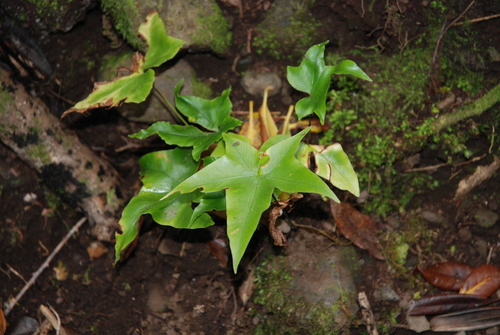
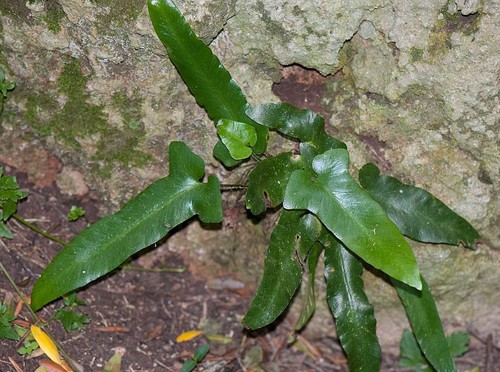
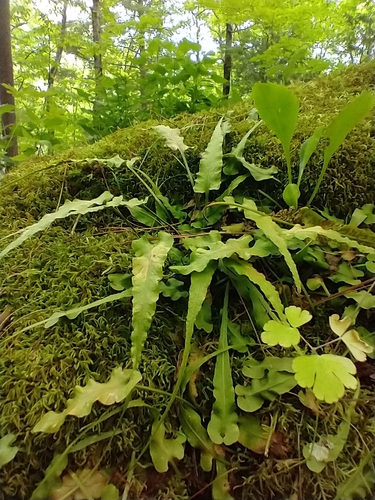
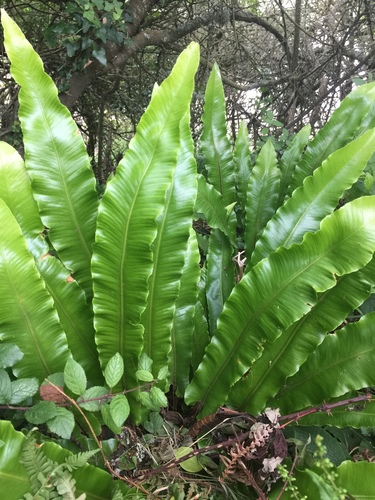
This species of fern, Asplenium scolopendrium L., has a most striking and unusual feature: its simple, strap-shaped, undivided fronds. Its common name "hart's-tongue fern" comes from the supposed resemblance of its fronds to the tongue of a hart, an archaic term for a male red deer. Asplenium scolopendrium is a common species native to the Old World. The nominate subspecies A. scolopendrium subsp. scolopendrium occurs throughout Europe, including the Caucasus and the British Isles, but it is absent from northeast Europe: Finland, Belarus, Latvia, Lithuania, and European Russia. Beyond Europe, this subspecies is found in the Middle East, North Africa (Morocco, Algeria, Tunisia, Libya, and the Canary Islands), and has been introduced to the Falkland Islands. Unlike the American variety of this species, European A. scolopendrium subsp. scolopendrium is widely used for horticultural purposes. Naturalized populations descended from cultivated European plants are found in North America, including New Brunswick and Ontario in Canada, and Maryland in the United States. Naturally occurring native North American populations are rare and widely scattered across separate locations: in the Mexican states of Chiapas, Coahuila, Nuevo León, and Oaxaca; on the Caribbean island of Hispaniola, in Haiti; along the Onondaga Limestone and Niagara Escarpment geological formations in Central New York (present in two counties); in southern Ontario (present in seven counties); and in the eastern Upper Peninsula of Michigan (present in two counties). Disjunct native populations also exist in Alabama and Tennessee, and these southern populations face dire risk of extirpation. In Alabama, populations are located at Fern Cave National Wildlife Refuge, a refuge centered on an off-limits cave in Jackson County where the population has declined heavily due to illegal plant collecting, and at an undisclosed, protected, off-limits pit in Morgan County. In Tennessee, the species is present in just a single county. An introduced population descended from New York native plants grows in New Jersey; it is a remnant of a 1936 ex-situ conservation effort for New York populations. In 2020, a new population of hart's-tongue ferns was discovered inside a cave with basaltic lava flows in El Malpais National Monument, Cibola County, New Mexico. This is the first confirmed population of the species in North America west of the Mississippi. Genetic analyses and surveys are currently underway to assess this population's genetic variation and overall health. In East Asia, the subspecies A. scolopendrium subsp. japonicum is distributed across the Russian Far East, northeastern China, and the Korean Peninsula. It is generally rare on the East Asian mainland, but relatively abundant on many islands including the Japanese Archipelago. The unique dispersal pattern of Asplenium scolopendrium has attracted attention from international botanists; the existence of these distinct varieties has been hypothesized to support the idea that these populations arose after colonization events involving only a single spore. Asplenium scolopendrium grows on neutral, calcium-rich, or lime-rich substrates under deciduous hardwood canopies, usually sugar maples in eastern North America. Suitable substrates include moist soil and damp crevices in old walls, and the fern is most commonly found in shaded areas. Individuals growing in full sun are usually stunted and yellowish, while those growing in full shade are dark green and healthy. The disjunct North American populations in the southeastern United States grow exclusively in sinkhole pits or limestone caves, and these populations may be relicts of cooler Pleistocene climates. Asplenium scolopendrium is frequently grown as an ornamental plant. Several cultivars have been selected for varied frond forms, including frilled frond margins, forked fronds, and cristate fronds. Both the species and the cultivar 'Angustatum' have received the Royal Horticultural Society's Award of Garden Merit. The American variety of this fern is widely reported to be difficult to cultivate, which complicates conservation efforts for the variety. As a result, almost all cultivated Asplenium scolopendrium individuals are derived from the Old World subspecies. In the 1800s, this fern was used as a medicinal plant in folk medicine as a spleen tonic, which explains the archaic genus name "spleenworts", and for other folk medicine uses. An 18th-century manuscript written by Katharine Palmer contains a recipe for hart's-tongue ale.