About Asplenium rhizophyllum L.
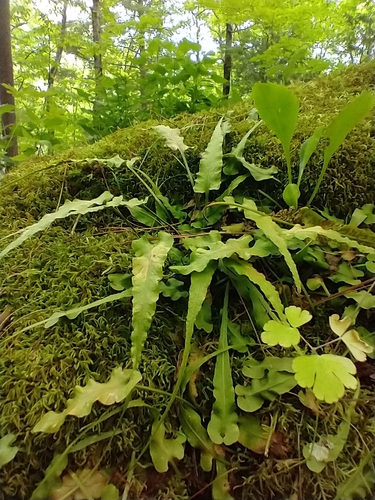
Asplenium rhizophyllum, commonly known as walking fern, is a small fern with a highly distinctive appearance. It has undivided, evergreen leaves with long, narrow tips that sometimes curve back and take root. It grows in tufts, which are often surrounded by new young plants produced from the rooting leaf tips. The leaves of younger plants tend to lie flat against the ground, while the leaves of older plants grow more erect or arching. The main native range of A. rhizophyllum centers on the Appalachian Mountains and the Ozarks. Its full range extends from southern Quebec and Ontario, along the Appalachians and Piedmont southwest to Mississippi and Alabama. It also reaches through the Ohio Valley into the Ozarks as far west as Nebraska and Oklahoma, and extends north along the Mississippi Valley to Wisconsin and Minnesota. This species is now extinct in Maine and Delaware, and is considered presumably extinct in Texas, where only a single 19th-century plant collection has been recorded. Its distribution is typically tied to areas with limy soil. While it is often described as rare, it is more accurately locally abundant in habitats where growing conditions suit it. Walking fern most often grows on shaded boulders, ledges, and in rock crevices, which are usually covered with moss. In rare cases, it can be found growing as an epiphyte on fallen tree trunks, or directly on the ground. It usually grows on limestone or other alkaline rocks, and only rarely grows on sandstone or other acidic rocks. Globally, this species is secure, holding a G5 conservation status. However, it is considered endangered at the edge of its range in some U.S. states and Canadian provinces. It is only known from historical records in Delaware and Maine. NatureServe ranks the species as critically imperiled (S1) in Mississippi, New Hampshire, and Rhode Island; imperiled (S2) in Michigan and South Carolina; and vulnerable (S3) in Kansas, North Carolina, Oklahoma, and Quebec. This fern was first introduced into cultivation in England in 1680. It grows best in low to medium light, in a moist, basic potting mix or garden soil with added lime chips.