About Asplenium resiliens Kunze
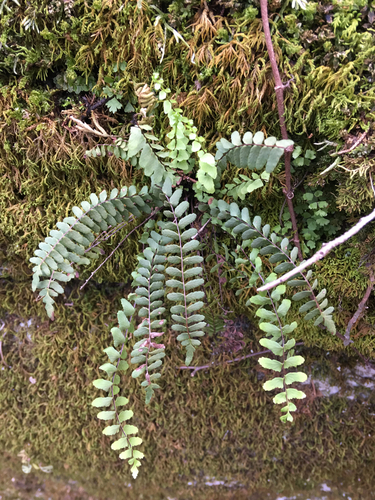
Asplenium resiliens Kunze is a small fern that grows in erect, dense tufts, with pinnate fronds, a shiny black stipe (leaf stalk below the blade) and rachis (leaf axis). Sterile and fertile fronds look similar to one another. Its roots are thin and wiry, and do not spread to form new plants. The rhizome is short and erect, about 2 millimeters (0.08 in) in diameter, and has been described as either sometimes branching or unbranched. It bears stiff scales that are filamentous, linear, or lance-shaped; these scales are blackish, either obscurely clathrate (with a lattice-like pattern) or entirely black. The scales measure 3 to 5 millimeters (0.1 to 0.2 in) long and 0.2 to 0.6 millimeters (0.008 to 0.02 in) wide, with untoothed, often brown margins and long, tapered tips. The entire erect leaf varies from 3 to 45 centimeters (1.2 to 18 in) long and 0.5 to 2.5 centimeters (0.20 to 0.98 in) wide. The stipe is straight, stiff, and colored glossy black to purplish-black. It may be smooth, or bear scattered blackish-brown threadlike scales 1 to 1.5 millimeters (0.039 to 0.059 in) long, plus tan, club-shaped appressed (flat-lying) hairs 0.1 to 0.2 millimeters (0.004 to 0.008 in) long. The stipe is 1.5 to 3 centimeters (0.6 to 1 in) long, rarely reaching 5 centimeters (2 in), and makes up one-tenth to one-quarter or one-third of the total blade length. It is round in cross-section, slightly flattened on the upper side, and may have indistinct 0.1 to 0.3 millimeter (0.0039 to 0.012 in) wings on either side, or lack wings entirely. The leaf blade is linear, sometimes slightly wider just below the tip or just above the base. It measures 4 to 35 centimeters (1.6 to 14 in) long and 1 to 2 centimeters (0.4 to 0.8 in) wide, occasionally reaching 2.5 centimeters (0.98 in) wide. It tapers abruptly to a lobed, pointed tip and tapers gradually toward its base. Unlike the related species Asplenium palmeri (Palmer's spleenwort), it does not grow proliferating buds at the blade tip; the pinnatifid portion of the blade is often deciduous, leaving a bare rachis behind. The blade is hairless, or may have scattered 0.1 millimeter (0.004 in) club-shaped hairs on its underside. The leaf tissue is often bluish-green, thick in texture, and not quite leathery. Like the stipe, the rachis is rounded, blackish, and shiny; it may be smooth or carry a few of the same tan hairs found on the stipe. The winging of the stipe extends up the rachis, and has been variously described as parallel cartilaginous ribs with a narrow green leafy wing that fuses into a single wing toward the leaf tip, or a whitish to tan wing matching the dimensions of the stipe's wing. The blade is divided into pinnae along its full length, with 20 to 40 pinna pairs per leaf. The pinnae are sessile (stalkless) or have very small stalks, and are rectangular in shape, tapering slightly toward the tip. In specimens from North America and Mexico, middle pinnae measure 10 to 20 millimeters (0.4 to 0.8 in) long (rarely as small as 4 millimeters (0.2 in)) and 2 to 5 millimeters (0.08 to 0.2 in) wide. In Guatemalan specimens, pinnae typically measure 1.5 to 8 millimeters (0.059 to 0.31 in) long and 1 to 3 millimeters (0.04 to 0.1 in) wide, with a typical length-to-width ratio of 1.5 to 2.5. Most pinnae have an auricle (small lobe) at their base that points toward the blade tip; occasionally, auricles pointing toward the blade base are also present. Pinna edges are untoothed or have shallow rounded teeth (exceptional shade-grown specimens may have deep rounded teeth), and are often rolled under. Pinna tips are blunt. The lower pinnae are widely spaced on the rachis and curve reflexed downwards. Leaf veins are free (they do not reconnect to each other) and difficult to see; fertile veins fork once and do not end in hydathodes (prominent swellings). Fertile pinnae have 2 to 6 pairs of sori (rarely as few as 1 pair or as many as 10), each about 1 millimeter (0.04 in) long, positioned on both sides of the midrib; the sori crowd near the pinna edges and often merge as they age. The indusia that cover the sori are 0.8 to 1.5 millimeters (0.031 to 0.059 in) long (rarely up to 2 millimeters (0.079 in)) and 0.3 to 0.5 millimeters (0.01 to 0.02 in) wide, colored greenish, pale yellowish, or whitish, and opaque, with straight or slightly jagged edges. They remain after spores mature, but may be hidden by mature full sporangia. Asplenium resiliens has a chromosome number of n = 2n = 108, and produces 32 unreduced, round or egg-shaped spores per sporangium. Asplenium resiliens is distributed across the southern United States, Mexico, Hispaniola, Jamaica, Guatemala, and South America, ranging from Colombia and Venezuela south to northern Argentina, Uruguay, and Brazil. Within the United States, it occurs from Florida west to Arizona and southern Nevada, and north to south-central Pennsylvania. It is found across most of Mexico, and is most abundant in the northeast, in Nuevo León and Coahuila. In Guatemala, it is known from the western departments of Huehuetenango, El Quiché, and Sololá. In Argentina, it follows the mountain arc from Jujuy Province south to the Sierra de la Ventana in Buenos Aires Province; it is also recorded from the western province of Mendoza, in the departments of Las Heras and Luján de Cuyo. It grows on or at the base of cliffs or sinkholes, on limestone or other alkaline rocks, though specimens have also been found in crevices of granite and sandstone. Growth directly on soil is rare. It may occur in forests, on boulders, on ledges, and in cliff crevices. It grows at altitudes from 100 meters (300 ft) in North America up to 3,900 meters (13,000 ft) in Guatemala. Plants growing at altitudes of 3,000 meters (9,800 ft) or higher are stunted and more compact than usual, with leaves 4 to 10 centimeters (2 to 4 in) long and overlapping pinnae just a few millimeters in length. These differences, observed in Guatemalan and Peruvian specimens, are thought to result from environmental factors rather than taxonomic differentiation. Asplenium resiliens is a triploid that reproduces apogamously, producing 32 spores per sporangium. In 1937, specimens with 64 well-formed spores per sporangium, believed to be sexually reproducing, were collected from Green Gulch in the Chisos Mountains, but all other specimens collected from the area since then have the typical 32 spores per sporangium. While the species is globally secure (ranked G5 by NatureServe), it is considered endangered in many states at the northern edge of its North American range. NatureServe ranks it as critically imperiled (S1) in Colorado, Illinois, Maryland, Mississippi, Nevada, Ohio, Pennsylvania, South Carolina, and Utah; imperiled (S2) in Indiana, Kansas and North Carolina; and vulnerable (S3) in West Virginia. It has gone extinct in Louisiana after the limestone caprock of a salt dome at Winnfield, its only location in the state, was quarried away. It is also believed to be extinct in Ohio, where it was last collected in 1900, even though suitable habitat still exists there. Quarrying of the calcareous rocks the species grows on poses a low-level threat to the species. In cultivation, Asplenium resiliens tolerates cold down to USDA hardiness zone 6. It prefers moist conditions, a basic potting soil, and a medium amount of light.