About Asplenium platyneuron (L.) Britton, Sterns & Poggenb.
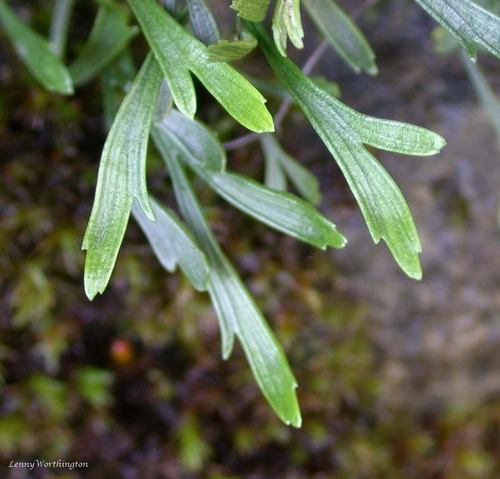
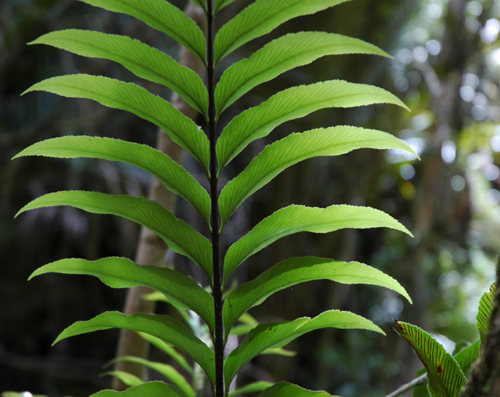
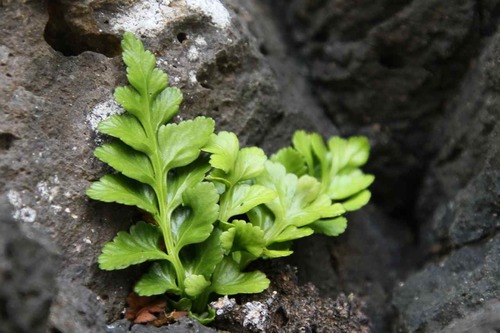
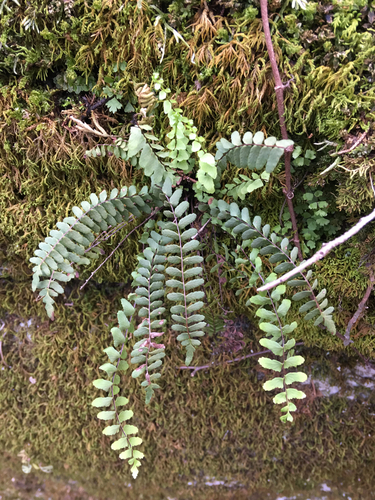
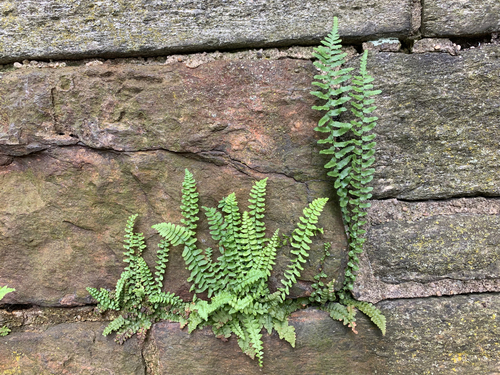
Asplenium platyneuron, commonly called ebony spleenwort, is a small tuft-forming fern with pinnate fronds. It has a shiny reddish-brown stipe and rachis, and produces two distinct forms of fronds: long, erect, dark green fertile deciduous fronds, and shorter, spreading, lighter green sterile evergreen fronds.
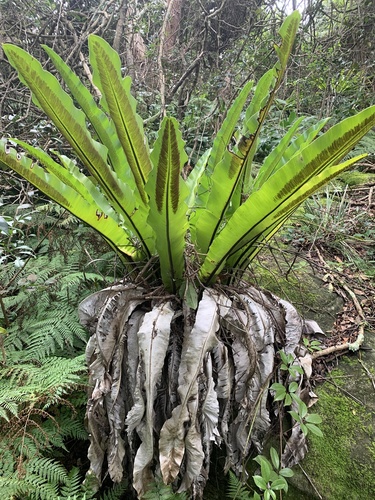
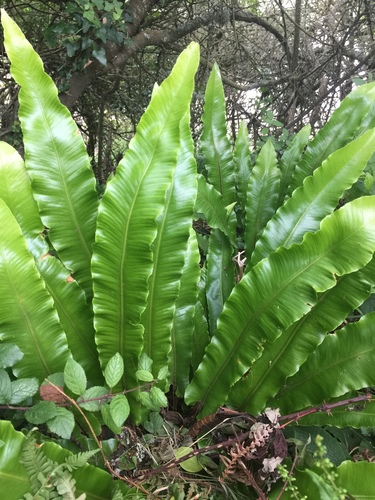
Several similar species can be distinguished from A. platyneuron by key traits. The most similar species is black-stemmed spleenwort (A. resiliens), which has a darker stipe and pinnae arranged opposite rather than alternate along the rachis. Maidenhair spleenwort (A. trichomanes) also has pinnate divisions and a dark glossy rachis, but its pinnae are oval and rounded rather than broadly oblong, and are usually less than twice as long as wide. Neither A. resiliens, A. trichomanes, nor any other pinnate American spleenwort have dimorphic fertile and sterile fronds like A. platyneuron. A. platyneuron is also very similar to Boydston's spleenwort (Asplenium × boydstoniae), an extremely rare backcross with Tutwiler's spleenwort (Asplenium tutwilerae); Boydston's spleenwort differs in having an elongated, acute frond tip like that of A. tutwilerae. Among similar South African spleenworts, A. lunulatum has proliferating frond tips, while A. monanthes has only one sorus per pinna. Among larger ferns, young A. platyneuron may be confused with Christmas fern (Polystichum acrostichoides), but Christmas fern is generally much larger and has a green, scaly stipe and rachis. Fishbone fern (Nephrolepis cordifolia) is also larger than A. platyneuron, with yellowish-green pinnae and a green rachis.
In North America, A. platyneuron is native across the eastern United States, ranging from southern Maine to the southeastern corner of Wisconsin, south to Florida, and west to eastern Nebraska, Kansas, Oklahoma, and Texas. It is also present in the far southeast of Canada, occurs around the border intersection of Colorado, New Mexico, and Oklahoma, and has isolated small populations in New Mexico, Arizona, and the West Indies. Outside North America, it grows in tropical and subtropical southern Africa; this distribution is unique among North American ferns. Its South African range extends from the Western Cape province north along the eastern seaboard to Gauteng and Mpumalanga provinces, and includes Lesotho. An isolated population was discovered on serpentine soil in a Slovakia oak woodland in 2009. Since the 1960s, A. platyneuron has spread rapidly and aggressively in the Great Lakes region, where it was formerly uncommon. While it is widespread across southern Africa, it is not particularly abundant there, and is most commonly found in Lesotho.
A. platyneuron grows in a wide variety of habitats at altitudes between 0 and 1,300 meters (0 to 4,300 ft). It tolerates soils ranging from mediacid (pH 3.5–4.0) to subalkaline (pH 8.0–8.5), though it prefers subacid soils (pH 4.5–5.0) over mediacid soils. Unlike many other North American spleenworts, it can grow on both soil and rock. When growing on soil, it occurs in forests, woodlands including sandy pinelands, old fields, and other disturbed sites. It can colonize a variety of rocks, particularly but not limited to calcareous rocks, and will also grow on mortared walls. In South Africa, it is generally found at altitudes over 600 meters (2,000 ft), in similar habitats to those it prefers in North America. It grows under small bushes and on rocky banks, and typically occurs in partial light rather than full shade or full sun, found at the base of rocks in grasslands, at forest edges, and in Leucosidea scrub.
Protein extracts from A. platyneuron have been shown to significantly deter insect predation on soybeans, and the Missouri Botanical Garden notes that the species has no serious insect or disease problems. However, a several-hundred-individual population of A. platyneuron in Florida was reported to have been nearly eliminated by insect activity. The species is susceptible to slugs, and the black fern aphid (Idiopterus nephrelepidis) can feed on it. Sporophytes are fairly drought-tolerant but require well-drained soils. The prothallia (gametophytes) of A. platyneuron can survive drought periods of up to a month. There is some evidence that prothallia may undergo clonal reproduction through fission, a trait that has been induced in the laboratory by varying light intensity.
Compared to other spleenworts, A. platyneuron has multiple adaptations that make it an aggressive colonizer, sometimes considered weedy, though climate warming and increased second growth habitat may also have contributed to its expansion in the Great Lakes region. It tolerates broad variation in soil conditions including pH, and will grow in both sun and shade. Starchy stipe bases provide energy for rapid spring growth, allowing fronds to outpace competing vegetation. Its erect fertile fronds, an unusual trait for the genus Asplenium, help release spores into wind for long-distance dispersal, while proliferative buds allow clonal propagation in moist, fertile habitats. The species carries a very low genetic load, so viable sporophytes develop from intragametophytic self-fertilization with 83–89% success. This means new sporophytes can usually grow from the gametophyte formed by a single spore, allowing ebony spleenwort to act as an early colonizer from distant locations of recently disturbed habitats, such as coal spoils in southern Iowa. The presence of A. platyneuron in a disturbed Slovakian habitat 6,500 kilometers (4,000 mi) from the nearest known eastern North American populations is likely the result of long-distance dispersal, which may also have allowed it to colonize and naturalize in South Africa.
While ebony spleenwort is globally secure (ranked G5), it is considered endangered in some states and provinces along the northern and western edges of its North American range. NatureServe ranks it as critically imperiled (S1) in Arizona and Colorado, imperiled (S2) in Nebraska, Maine, Rhode Island, and Quebec, and vulnerable (S3) in Florida and Minnesota.
Ebony spleenwort is sometimes grown as a terrarium plant or garden plant. It can be cultivated in sandy peat, subacid garden soil, other gravelly, sandy or gritty soils, or potting mix, under moist to dry conditions. Both acid and alkaline soils are acceptable. Good drainage is essential, and the species will even grow in dry soil. Partial sun or low to high light is recommended, though it tolerates full shade. Plants are reported to be easy to maintain once established, but it has been described as rather difficult to grow in Germany. Cultivator Conrad Loddiges found it necessary to use artificial heat to grow ebony spleenwort in Great Britain.