About Asplenium pinnatifidum Nutt.
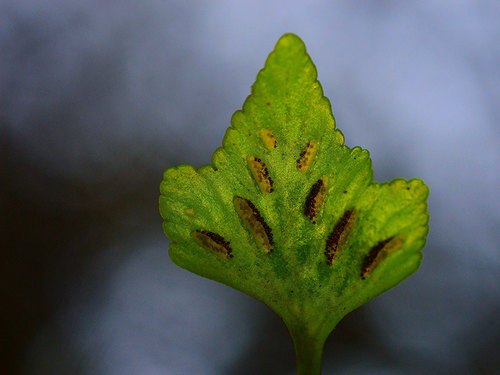
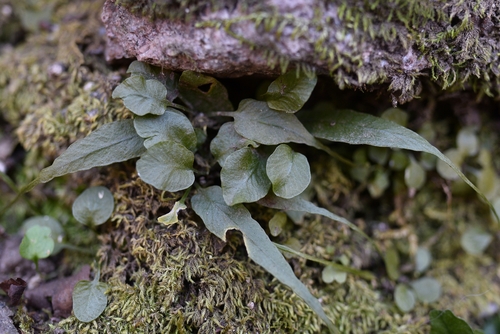
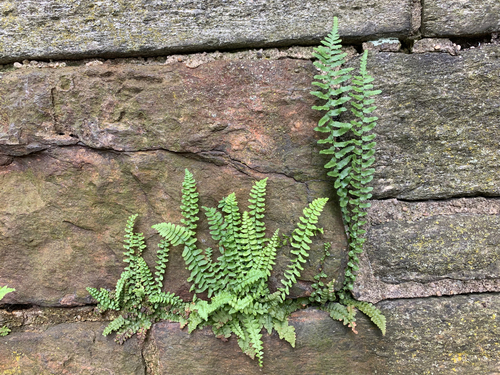
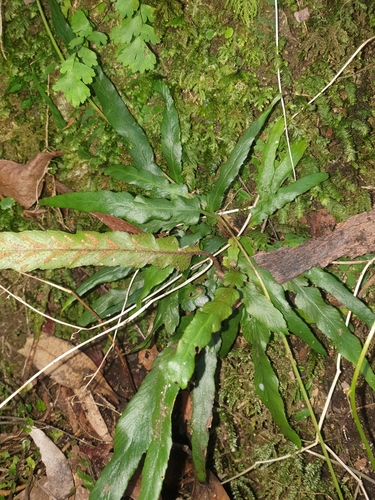
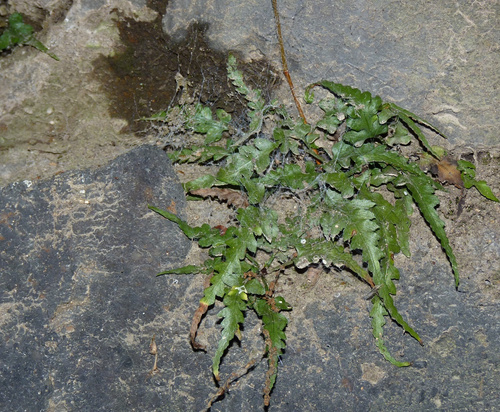
Asplenium pinnatifidum Nutt. is a small, evergreen perennial fern that grows in tufts, with bright green, wrinkled pinnatifid (lobed) fronds. Notable features of this species include a shiny leaf stalk (stipe) that is only dark at its base, and long-tapering leaf blades with variable lobing. Fronds are monomorphic, meaning sterile and fertile fronds share the same size and shape. The roots are not proliferous, so clusters of leaves grow from a single, frequently branched rhizome with closely spaced leaves. The rhizome is approximately 1 millimeter in diameter, covered in dark reddish-brown to blackish, narrowly triangular (deltate) scales that are strongly clathrate (lattice-patterned). These scales measure 3 to 5 millimeters long and 0.3 to 0.5 millimeters wide, with untoothed (entire) edges. The stipe is shiny and dark reddish-brown at the base, fading to green over its upper one-third to one-half. It bears scales similar to the rhizome at its base, which reduce to hairs along the upper stipe, and may have narrow wings extending from the leaf base to near the stipe base. The stipe is 1 to 10 centimeters long, and ranges from one-tenth to one and one-half times the length of the leaf blade. The leaf blade is overall narrowly deltate or lanceolate, sometimes with an irregular outline, and tapers to a long point. The length and degree of this taper varies between specimens, ranging from merely acute to acuminate or attenuate. Blades are generally curled with downward-pointing tips. The blade tip sometimes develops a swelling that can differentiate into a proliferous bud, and very rarely into a plantlet, similar to the growth seen in walking ferns. When buds form, adventitious sporangia may appear around them, unusually even on the upper leaf surface. The base of the blade may be squared off or notched to varying degrees along the leaf's central axis (rachis). Blades range from 2 to 17 centimeters long, rarely reaching 20 centimeters, and 1 to 4 centimeters wide, rarely reaching 13 centimeters. The blade tissue is thick and somewhat leathery. Blades are either entirely pinnatifid (lobed but not fully separated) or cut to form a single pair of pinnae at the base. When present, pinnae are roughly oval or triangular, sometimes narrow, measuring 5 to 20 millimeters long, rarely up to 90 millimeters, and 0.4 to 1 millimeter wide, rarely up to 1.2 millimeters. The base of pinnae may be squared off or tapered to a point, their edges range from wrinkled to toothed, and their tips vary from rounded to pointed. Blade lobes gradually decrease in size toward the blade tip, sometimes becoming simply wavy. The rachis is green, sometimes turning tan when dry. A small number of scattered small hairs occur on the underside of the rachis and blade. This species is highly morphologically variable overall; younger blades may have completely unlobed or just wavy edges. Its veins are free and forking, only rarely rejoining to form net-like patterns (anastomosing). Each segment (pinna or lobe) of a fertile frond bears 1 to 6 sori, with more than forty occurring in extreme cases. Sori usually fuse together as they age, and measure 1 to 2 millimeters long. They are covered by persistent, thin, whitish indusia with untoothed edges. Each sporangium holds 64 spores. The sporophyte of this species has a chromosome number of 144, indicating an allotetraploid origin. Asplenium pinnatifidum shares some similarities with its parent species A. rhizophyllum, but can be distinguished by being distinctly lobed when mature, typically having longer stipes relative to leaf size, and having a more upright growth habit. It may be confused with A. dalhousiae (Countess Dalhousie's spleenwort), which occurs in Asia and the American Southeast; A. dalhousiae has short, dull stipes covered in larger, toothed scales. It closely resembles the hybrid A. × ebenoides (Scott's spleenwort, including fertile A. tutwilerae, Tutwiler's spleenwort), but these taxa have a completely dark stipe, with the dark color extending into the rachis, and longer blade lobes. Among hybrid taxa that have A. pinnatifidum as a parent, it is most similar to A. × gravesii (Graves' spleenwort), a hybrid with A. bradleyi (Bradley's spleenwort), with less similarity to A. × trudellii (Trudell's spleenwort) and A. × kentuckiense (Kentucky spleenwort). In A. × gravesii, dark stipe color extends to the base of the leaf blade, blades usually have more than one pair of pinnae, and blade edges are shallowly wrinkled or toothed. Additionally, the basal pinnae (which may themselves be pinnatifid) lack stalks, the leaf blade is pointed at the tip but not drawn out into a long taper, and plants typically produce fewer fronds. The sori of A. × gravesii are dark brown rather than cinnamon brown. A. trudellii is fully pinnate in the lower half of the blade, and its pinnae are toothed. A. × kentuckiense is also fully pinnate toward the base of the blade, with four to six pairs of pinnae, and the brown stipe color extends upward into the basal portion of the rachis. This species is native to eastern North America, where it occurs in the middle and southern Appalachian Mountains, ranging from Pennsylvania and New Jersey southwest to Alabama and the northeastern corner of Mississippi. It is also found in the Shawnee Hills and to some extent in the Ozarks, with isolated outlying occurrences in southeastern Oklahoma and Iowa County, Wisconsin. Early reports of the species from New England were later determined to be variants of the hybrid A. × ebenoides. Asplenium pinnatifidum grows on acidic rocks, often in steep habitats, at altitudes from 0 to 1,000 meters. Sandstone is its most common substrate. It requires weathered rock-derived soil with pH ranging from subacid (pH 4.5–5.0) to mediacid (pH 3.5–4.0) to grow. Globally, A. pinnatifidum is considered apparently secure (ranked G4), but it is endangered across much of its range. According to NatureServe, it is extirpated in New York, where it was only known from a single 1877 collection. It is ranked critically imperiled (S1) in Illinois, Maryland, Mississippi, New Jersey, Oklahoma, South Carolina, and Wisconsin, imperiled (S2) in North Carolina, and vulnerable (S3) in Arkansas, Georgia, Pennsylvania, and Virginia. It is threatened by land use change, habitat fragmentation, and certain forest management practices. Asplenium pinnatifidum can be cultivated in rock gardens and terraria. It prefers medium light, and grows well in moist soil or potting mixture; some cultivation guidelines recommend adding sandstone chips to the growing medium.