About Asplenium nidus L.
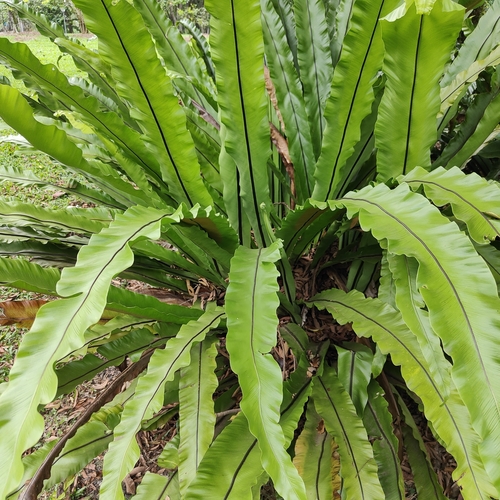
Asplenium nidus L. forms large simple fronds visually similar to banana leaves. Most fronds grow 50–150 centimetres (20–59 in) long and 10–20 centimetres (3.9–7.9 in) broad, while occasional individuals can reach up to 200 cm (79 in) long by up to 60 cm (24 in) wide. The fronds are light green, often crinkled, with a black midrib, and exhibit circinate vernation. Spores develop in sori on the underside of the fronds. These sori form long rows extending out from the midrib on the back of the outer part of the frond lamina. As fronds brown, they roll back and create a massive leaf nest in the branches and trunks of trees. Some plants growing in the Philippines have fronds up to 135 cm (53 in) long while only 3.7 cm (1.5 in) wide. This species is native to east tropical Africa (Tanzania, including the Zanzibar Archipelago); temperate and tropical Asia (Indonesia; East Timor; Kyushu island and the Ryukyu Islands of Japan; Malaysia; the Philippines; Taiwan; and Thailand); as well as northern Australia's Queensland and the Pacific Islands. Asplenium nidus can grow either as an epiphyte or a terrestrial plant, but typically grows on organic matter. This fern often lives in palm trees, where its leaf-rosette collects water and humus. It thrives in warm, humid areas in partial to full shade. It dislikes direct sunlight; when grown in gardens, it prefers full shade on a south-facing wall in the southern hemisphere, and on a north-facing wall in the northern hemisphere. With a minimum tolerated temperature of 10 °C (50 °F), Asplenium nidus is widely cultivated as a houseplant in temperate regions. However, many plants sold as A. nidus are actually the related Asplenium australasicum. Asplenium nidus has gained the Royal Horticultural Society's Award of Garden Merit. It has been used locally in folk medicine for asthma, sores, weakness, and halitosis. Its sprouts are eaten in Taiwan, where they are called 山蘇 (pronounced shansu, meaning mountain vegetable). They may be stir-fried or boiled, and are a traditional aboriginal vegetable, now popular enough to appear on the menus of chain restaurants. Young fronds are eaten in the Polynesian islands, called Luku in Niue, Laukatafa in Tuvalu and Laumea in Tokelau; they are often cooked and eaten with coconut cream. Large fronds are also used in wrapping and cooking food.