About Asplenium montanum Willd.
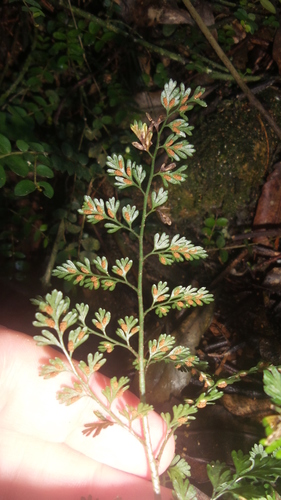
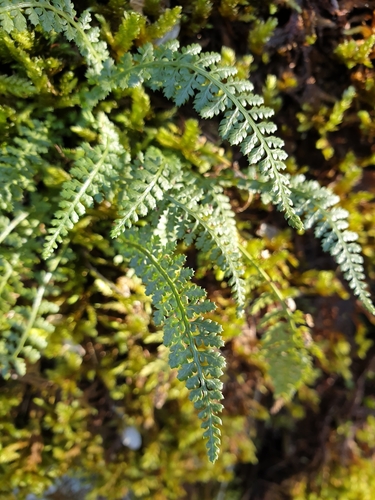
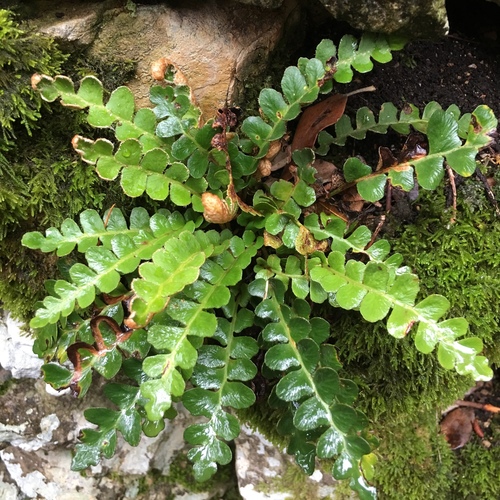
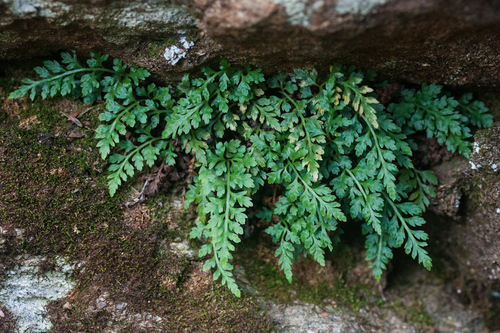
Asplenium montanum Willd. is a small, evergreen fern that grows in tufts. Its leaves are bluish-green, highly divided, and grow from a long, often drooping stalk. This species is monomorphic, meaning there is no difference in form between its sterile and fertile fronds. Its horizontal rhizomes measure roughly 1 millimeter across, may curve upward, and are unbranched. However, because new individual plants can grow from root tips, a tightly packed cluster of stems can appear to be branched. The rhizomes are covered in dark brown, narrowly deltate (triangular) scales 2 to 4 millimeters long and 0.2 to 0.4 millimeters across, with untoothed edges. The scales are strongly clathrate, meaning they carry a lattice-like pattern. The stipe, which is the leaf stalk below the leaf blade, is dark brown to purplish-black, shiny at the base, and gradually turns dull green as it extends upward to the blade. The stipe ranges from 2 to 11 centimeters in length, and may be 0.5 to 1.5 times the length of the leaf blade. Dark, narrowly lanceolate scales and tiny hairs are only found at the very base of the stipe, which is slender, fragile, and lacks wings. The leaf blade is thick, hairless, and dark blue-green. The rachis, the central leaf axis, is dull green like the stipe, with occasional hairs. The blade is shaped deltate or lanceolate, with a squared-off or slightly rounded base and a pointed tip. It measures 2 to 11 centimeters long and 1 to 7 centimeters wide, occasionally reaching up to 10 centimeters wide. The blade structure ranges from pinnate-pinnatifid to bipinnate-pinnatifid; that is, it is cut into lobed pinnae, and sometimes the pinnae themselves are cut into lobed pinnules. Each leaf holds four to ten pairs of widely spaced pinnae. Each pinna is deltate to lanceolate, with coarse incisions along the edges that cut it into pinnules or deep lobes, and has a rounded to angled base. The pinnules are indented, but not cut any further. The longest pinnae are located closest to the base of the leaf, and measure 6 to 35 millimeters long and 4 to 20 millimeters across. Leaf veins do not form a meshwork and are hard to see. On fertile fronds, 1 to 15 elliptical or narrow sori are found on the underside of each pinna. The sori are 0.5 to 1.5 millimeters long, covered by translucent, pale tan indusia with somewhat jagged edges. Each sporangium holds 64 spores. The sporophyte of this species has a chromosome number of 2n = 72, making it a diploid. The dark bluish-green leaf color and widely spaced, deeply cut and indented pinnae distinguish A. montanum from most of its close relatives. The pinnae of Bradley's spleenwort (A. bradleyi) are toothed and less deeply cut, and the dark color of the stipe extends partway up the rachis in A. bradleyi. Wall-rue (A. ruta-muraria) has a green stipe, and its pinnae have longer stalks and are broadest near the tip. Wherry's spleenwort (A. × wherryi), a hybrid between A. bradleyi and A. montanum, is intermediate between its two parent species. Compared to A. montanum, the blade of A. × wherryi is lance-shaped rather than triangular, the upper parts of the blade are less deeply cut, and the dark color of the stipe extends to the base of the rachis. As one of the "Appalachian spleenworts", A. montanum occurs in the Appalachian Mountains from Vermont and Massachusetts southwest to Tennessee, Alabama, and Georgia, and is less widespread in the Ohio Valley in Ohio, Indiana, and Kentucky. Populations were discovered in Garland County, Arkansas in 2002, and in Stone County, Arkansas in 2008. One outlying population in Missouri, collected in 1960 near Graham Cave, is now considered historical; it is represented by a single specimen and has never been relocated, and its original site is thought to have been destroyed by road construction. A collection from the Keweenaw Peninsula of Michigan made by Farwell was considered valid by M. L. Fernald, but its authenticity is now questioned, and the population has never been relocated. Asplenium montanum grows on acidic rocks such as sandstone, in crevices where moisture seeps from within the rock strata. It has been recorded at altitudes up to 2,000 meters. Like the closely related A. bradleyi, A. montanum requires the thin soil in its preferred crevices to be subacid (pH 4.5–5.0) to mediacid (pH 3.5–4.0), and cannot tolerate calcium. This habitat is unsuitable for most other plants, but its allotetraploid descendants and their backcross hybrids may grow alongside it. NatureServe ranks Asplenium montanum as globally secure (G5), but it is considered threatened at the edges of its range. It is only known historically from Missouri. NatureServe classifies it as critically imperiled (S1) in Indiana, Massachusetts, New Jersey, Rhode Island, and Vermont, and imperiled (S2) to vulnerable (S3) in Connecticut and New York. The main threat to New York populations is rock climbing. Asplenium montanum can be cultivated outdoors or in a terrarium. In both settings, the growing soil should be amended with chips of acidic rock.