About Asplenium antiquum Makino
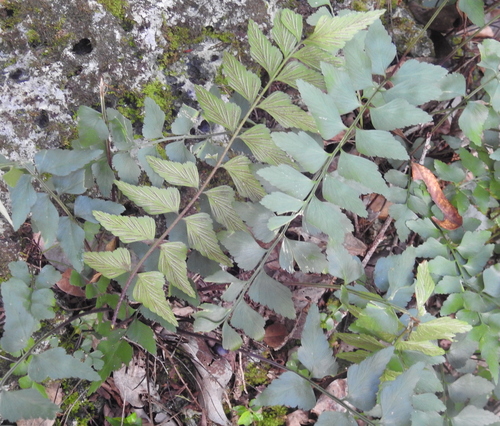
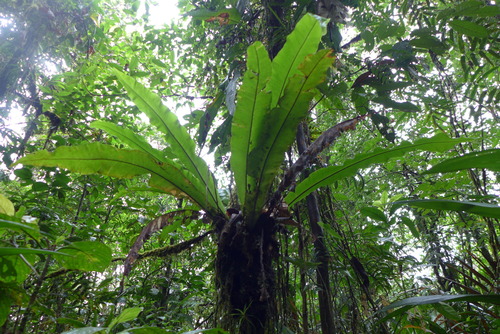
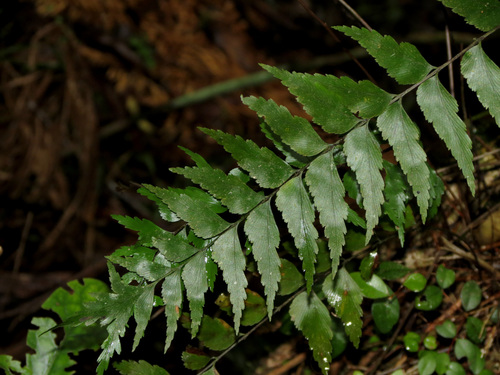
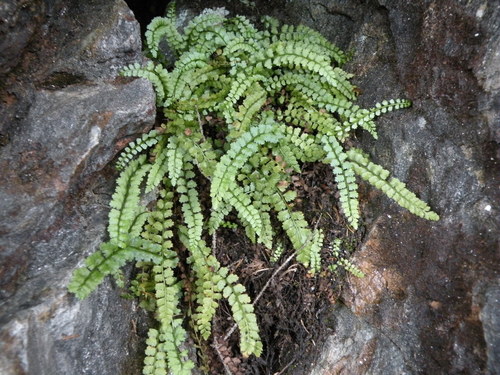
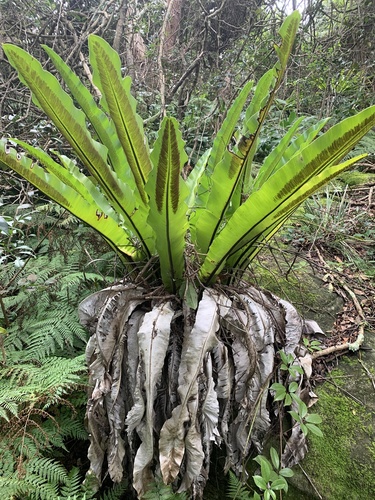
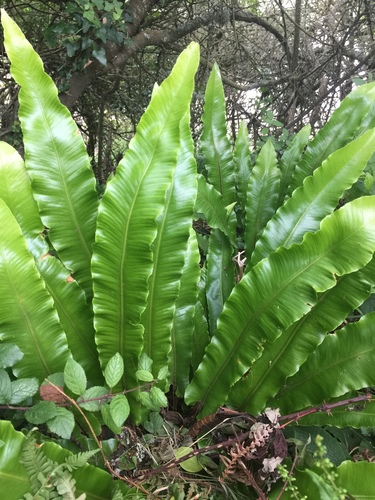
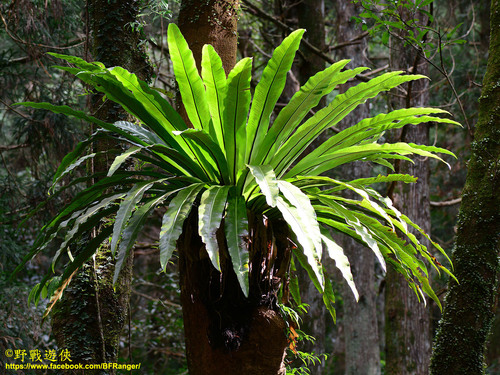
Asplenium antiquum Makino is an evergreen fern that grows to heights of 2–3 ft (60–90 cm). It produces bright green, arching frond blades with pointed tips and a prominent central midrib. This species can be easily told apart from the closely related Asplenium nidus by its fronds, which maintain a uniform width along their length. This fern is native to temperate and subtropical regions of East Asia, where it occurs in southern, eastern, and northeastern China, Japan, South Korea, and Taiwan. In its native range, it grows on rock faces, cliff outcroppings, and the branches and trunks of trees. In the native portions of its range located in Japan and South Korea, Asplenium antiquum is classified as an endangered species on the IUCN Red List. Despite its endangered status in Japan and South Korea, Asplenium antiquum is a fairly common ornamental plant in the nursery trade, and is widely sold across Asia, Australia, Europe, and North and South America. It can be grown outdoors year-round in select temperate and subtropical climates; for example, this is possible in sheltered, well-ventilated locations within USDA hardiness zones 9 and 10. In regions outside these zones, it can be kept outdoors from around May through October in the northern hemisphere, which corresponds to October through March in the southern hemisphere. When frost is a risk, or when nighttime temperatures fall below 40 °F (4.4 °C), this plant must be protected or brought indoors to grow as a houseplant. It requires consistently high humidity, though it must not be kept so saturated that rot develops. The ideal growing substrate for this species is aerated and well-draining, such as sphagnum moss, and should feel damp similar to a wrung-out sponge. It should be kept out of direct sunlight, but still provided with bright, indirect light. When grown indoors, Asplenium antiquum grows best in a well-ventidated greenhouse or terrarium, and it thrives in semi-hydroponic growing setups. Several cultivars and forms of this species are commonly available in the plant trade: Asplenium antiquum 'Crissie', 'Hurricane', 'Leslie', 'Osaka', and 'Victoria'.