About Aspidotis densa (Brack.) Lellinger
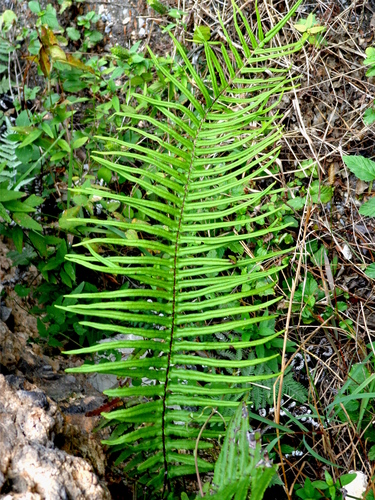
This fern species produces leaves with long, wiry, brown to black petioles (the stem located below the leaf blade). The leaf blade itself makes up less than half of the total leaf length when the petiole is included. Leaves grow from a short, creeping rhizome covered in firm, narrow scales. Where the petiole connects to the leaf blade, its stem transitions to green and develops a groove on its adaxial (top) surface.
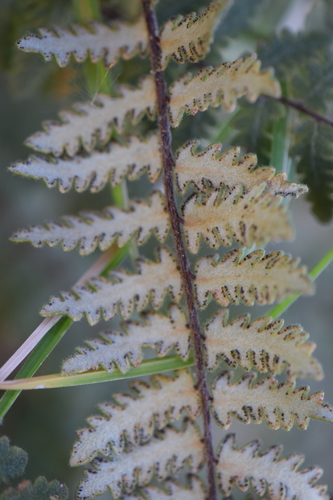
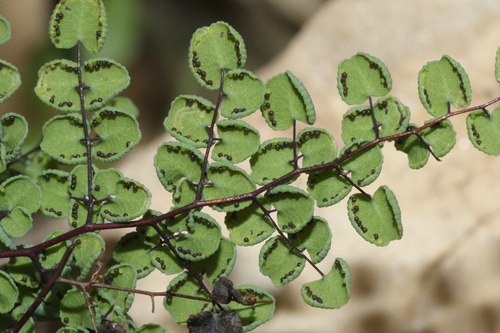
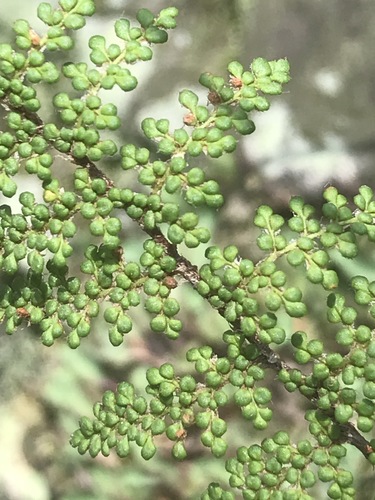
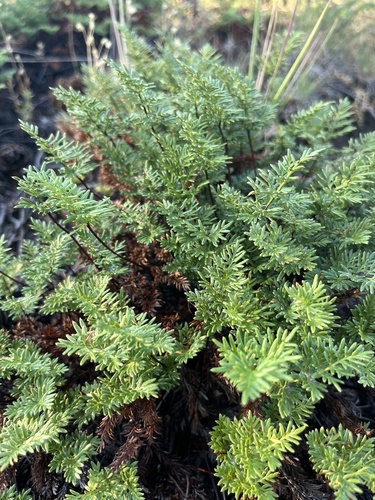
Leaf blades are medium to dark green, and sometimes have a glaucous or bluish tint. Each blade is triangular in shape and made up of many pinnae, which are further divided into narrow leaflets called pinnules. On fertile fronds, the undersides of the leaflets are covered in sori, and the edges of the leaflet fold over these sori to form a false indusium.
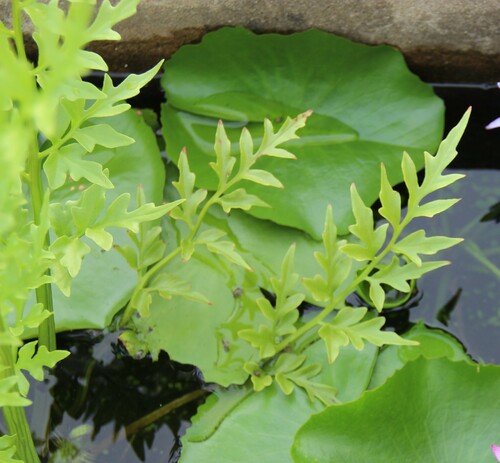
Most often, plants of this species only produce fertile fronds, but they sometimes show frond dimorphism. In dimorphic individuals, sterile fronds are shorter and have broader, flatter leaflets than fertile fronds, which grow taller on longer petioles. The leaflets of fertile fronds have folded-under edges, giving them a narrow, lace-like appearance. The flat leaflets of sterile fronds have toothed edges, but these teeth are usually reduced on fertile fronds and not easily visible, since the edges fold under to form the false indusium. Under certain growth conditions, plants will only produce sterile fronds. As with many ferns, new fronds grow in spring via circinate vernation.
Aspidotis densa grows in rocky habitats, most often on serpentine soils on rocky mountain slopes that are well-drained but seasonally moist. It usually grows in full sun, though it can tolerate partial shade. It can grow in rock crevices and exposed rocky outcrops, filling mossy cracks; over time it can creep to fill fissures, forming well-established colonies across the outcrop. While the species grows mostly on serpentine, it is also found on other rock and soil types. There are many recorded occurrences of the species west of Victoria, British Columbia, growing on mafic (basalt) hills where no ultramafic rock (including serpentine) has been mapped.
Aspidotis densa is native primarily to the west coast of North America, ranging from British Columbia south to California, and east to the Rocky Mountains in Idaho, Montana, and Wyoming. It has a disjunct population growing on serpentine soil in Frontenac National Park, Quebec. It also has other, closer likely disjunct populations in the Wasatch Mountains of Utah and in the Cuyamaca Mountains near San Diego, California; neither of these populations are apparently associated with serpentine. It typically grows in mountain habitats from low elevations up to around 3,000 meters. It also grows near sea level in a small number of coastal locations associated with serpentine, most notably in Marin County, California, and at Washington Park and Cypress Island near Anacortes, Washington.