About Aspidoscelis sexlineatus (Linnaeus, 1766)
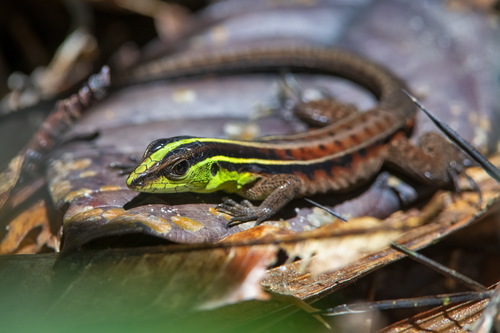
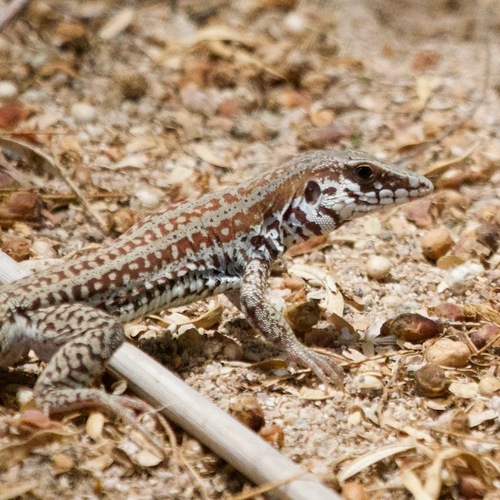
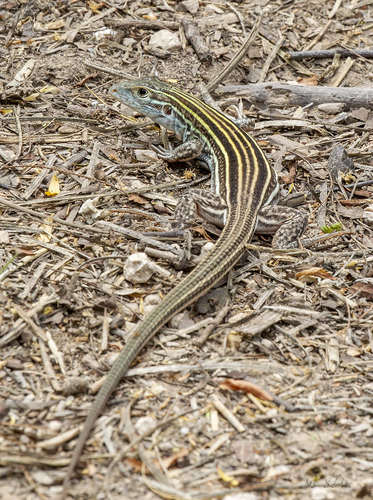
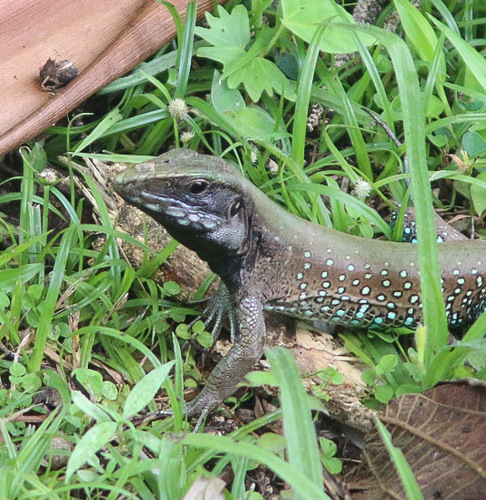
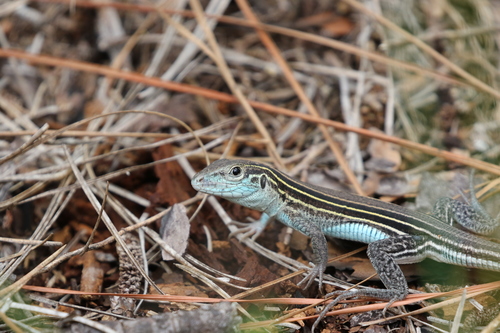
Aspidoscelis sexlineatus, commonly called the six-lined racerunner, is typically dark green, brown, or black, with six yellow or green-yellow stripes that run down the entire body from head to tail. Between these stripes are dark fields that range in color from dark brown to black, plus pale fields located near the ventral scales on each side of the body. The sides of the head, both above and below the lateral stripe, have distinct lemon-yellow coloration. This species also has white mental and gular stripes. The posterior gular fold is bordered by enlarged mesoptychial scales. The postantebrachial scales on the forearms are granular, and only slightly enlarged. Females usually have white undersides, though adult females may develop some pale blue coloration. Males have bright blue-hued chest and abdominal stripes, and sometimes have a pale green throat. Six-lined racerunners have slender bodies, with a tail that is nearly twice as long as the body. The long tail may act as a counterbalance, letting the lizard turn quickly to flee from predators. The six-lined racerunner is found across most of the southeastern and south-central United States. Its range extends from Maryland to Florida in the east, west across the Great Plains to South Texas and northern Mexico. In a study of this species in Mexico, most observed individuals lived near seashore areas shaped and influenced by maritime climate and hurricanes. The species' range also extends north to Wisconsin and Minnesota, and a small isolated disjunct population exists in Tuscola County, Michigan. Due to its large range, the six-lined racerunner lives in a wide variety of habitats, including grasslands, woodlands, open floodplains, and rocky outcroppings. Populations are also abundant in areas that experience frequent fires, such as longleaf pine stands in sandhills. It prefers lower elevations, dry loamy soils, and open xeric environments. In lower elevations, this lizard can also be found in human-altered disturbed areas such as under voltage towers, and along highways and railroads. It lays its nests near activity burrows alongside secondary highways and dirt roads, in well-drained locations. Breeding occurs in spring and early summer. Females lay up to six eggs in midsummer, and the eggs hatch six to eight weeks after being laid. A female may lay a second clutch of eggs several weeks after her first. During breeding season, males perform a behavior called "cloacal rubbing" to show arousal. In this behavior, the male rapidly rubs his cloaca and pelvic region on the ground, sometimes in a figure-eight pattern, while moving forward. When a male finds a receptive female, he straddles her, curves his body over hers, and bites her on the side opposite his cloacal region to begin copulation. Males also perform a behavior called "female tending", where they repeatedly charge at a female trying to leave her burrow until the female allows the male to approach and start reproduction.