About Aspidoscelis costatus (Cope, 1878)
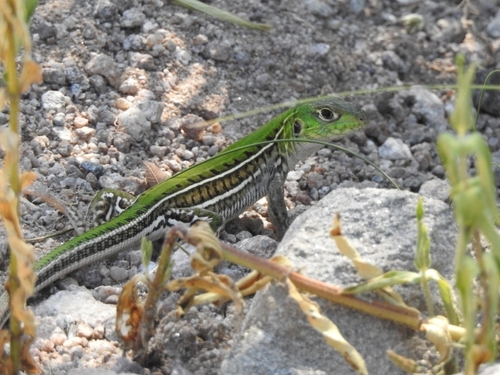
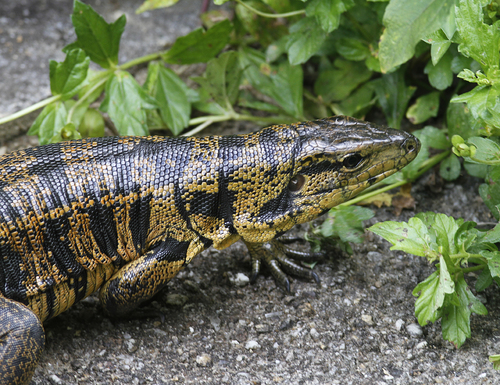
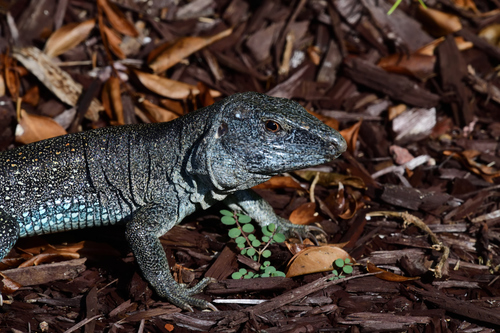
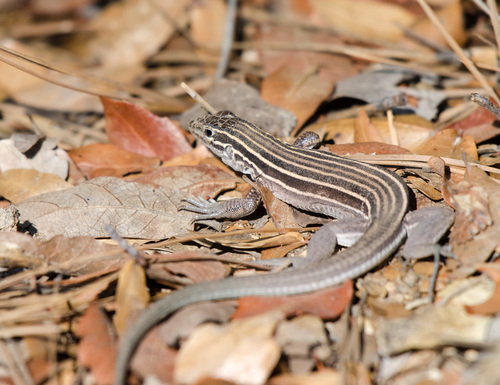
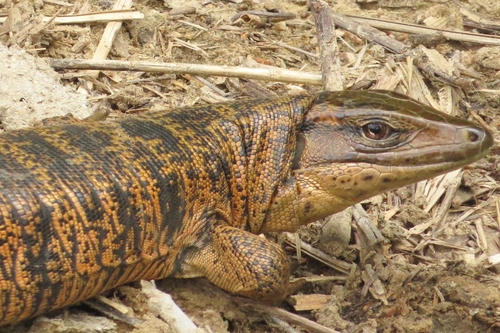
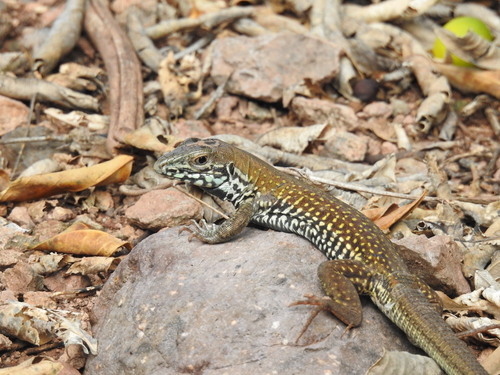
Aspidoscelis costatus, commonly called the Western Mexico Whiptail, is a striped lizard species with key identifying morphological features. It has scaly skin, bowed legs, a pointed snout, and no vertebral crests (spines). It has multiple straight dorsal stripes, with variable color patterns over a grey, brown, or black base ground color; the base is often mixed with pale spots or bar-like markings. On the lizard’s underside, the abdominal and pelvic regions are most often cream-colored, but can range from light to medium blue, and the pelvic region may even be red. The gular (throat) region can have more intense coloration ranging from pink to red. These color and pattern differences are the result of individual variation, ontogenetic (juvenile to adult) variation, sexual dimorphism between males and females, and seasonal changes. As males mature, their dorsal patterns shift from pale stripes with dark spaces between them and no spots, to patterned individuals with spots and varied pale markings on a black base. Females go through similar color changes as they age, but do not lose their striping as they grow. Ontogenetic changes to ventral coloration are also visible, with mature males becoming more colorful than females. This species belongs to the genus Aspidoscelis, which differs from the related genus Cnemidophorus in seven consistent morphological traits: Aspidoscelis has a posteriorly forked tongue, lacks the basal tongue sheath found in many other lizards, has smooth ventral scutes (enlarged belly scales), has eight rows of ventral scutes at midbody, has no anal spurs in males (anal spurs are structures that other male lizards use to stimulate and position females during mating), has abruptly enlarged mesoptychial scales in the gular throat region, and has three parietal scales (enlarged scales on the crown of the head) and three or four supraocular scales (enlarged scales above the eyes) on each side. Like crocodiles, Western Mexico Whiptails have nictitating membrane eyelids, also called third eyelids: this is a translucent membrane that draws from the inner corner of the eye across the eyeball when the lizard blinks, while the upper and lower eyelids stay open. This membrane moistens and protects the eye surface, and allows limited vision while the lizard blinks. Most whiptail lizard species prefer dry climates, and many live in the Sonoran Desert that spans northwestern Mexico and southern California, an area with sparse vegetation including sagebrush, low desert scrub, grasslands, woodlands, and pine forests. Aspidoscelis costatus similarly prefers natural habitats including savanna and shrubland in brushy, uneven terrain. It also extends into open areas of tropical low deciduous forest, thorn forest, low spiny sub-evergreen forest, and medium sub-deciduous forest, occurring across both temperate and tropical climates in western and southwestern Mexico. Substantial habitat clearance for intensive agriculture and human settlements has led to the formation of urban populations of A. costatus, even in densely populated cities; this is documented for the subspecies Aspidoscelis costatus costatus, commonly called the Balsas Basin Whiptail. One study notes that global warming has impacted the species’ habitats: some climatic groups of A. c. costatus have reduced distributions, while others have expanded distributions. This species may potentially shift its distribution to higher elevations in response to rising temperatures. As striped lizards, Western Mexico Whiptails are active foragers that move more constantly than lizards with cryptic body patterns, recording very high rates of moves per minute and high percentages of time spent moving. All whiptail lizards in the genus Aspidoscelis are active when their body temperatures fall between 37 and 40 °C (99 and 104 °F). Because they rely on sunlight to warm their bodies for activity, whiptails adjust their behavior to access heat sources. Larger whiptails spend more time in shaded areas to avoid overheating, while smaller whiptails heat and cool more quickly, so they can comfortably occupy open areas even during summer. Aspidoscelis whiptails are not sit-and-wait ambush predators; they are active foragers that move very frequently, almost constantly, using short steps at a frenetic pace. Foraging is their primary daily activity. When moving under plants or through leaf litter, their jerky, start-stop movements create distinctive crunching sounds from disturbed dry leaves. When fleeing threats, they can run at top speeds of 18 mph (29 km/h), holding their tail straight behind their body and not whipping it as they run. Around one third of whiptail lizard species are parthenogenic, meaning they reproduce asexually via development of an unfertilized ovum, essentially cloning while maintaining some genetic diversity. This is not the case for Western Mexico Whiptails, which are a bisexual, dioecious species (with male and female reproductive organs in separate individuals) that reproduces sexually. Like most lizards, A. costatus males reproduce through the cloaca, a semicircular opening on the underside of the tail base, just beyond the hindlegs. The cloaca also eliminates digestive waste including urine and feces. Males have a bilateral pair of reproductive organs called hemipenes, which are held inverted inside the cloaca when not in use. During copulation, the hemipenes are everted, and sperm is ejaculated; usually only one hemipenis is used at a time. Females also use their cloaca to eliminate digestive waste and for reproduction; for females, the cloaca serves as the external genital opening for the genital canal, equivalent to the mammalian vagina. Copulation occurs via a cloacal kiss, where the male and female press their cloacas together so the male can deposit sperm. As noted for the genus, male A. costatus do not have anal spurs (also called pelvic spurs), the vestigial limb structures that other male lizards use to stimulate and position females during mating.