About Aspidites ramsayi (Macleay, 1882)
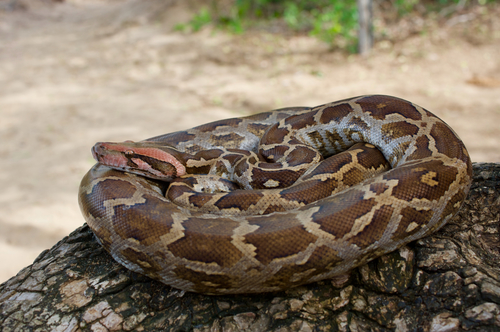
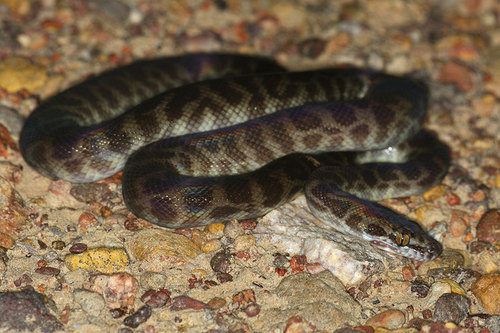
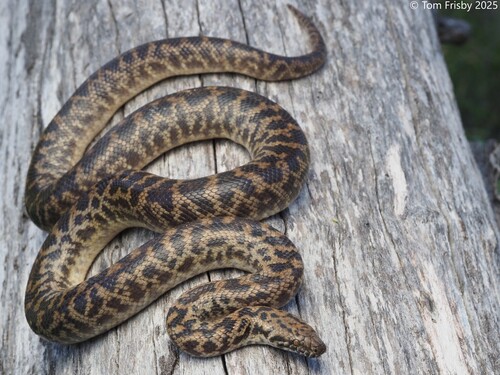
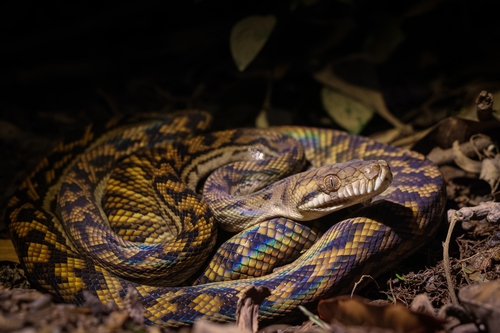
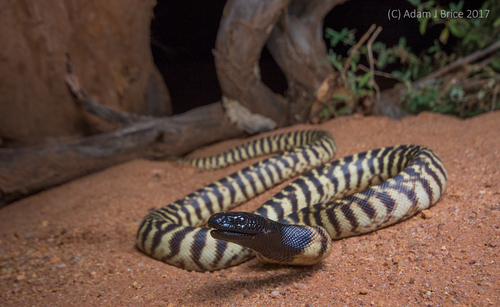
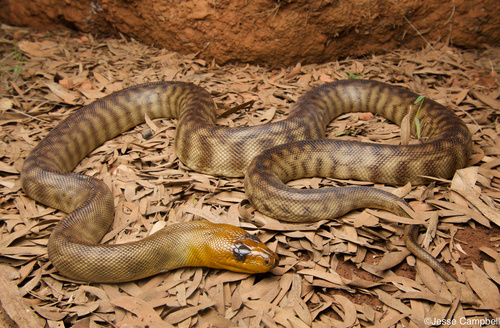
Description: Adult Aspidites ramsayi typically reach a total length (including the tail) of around 1.5 m (4.5 feet). This species has a narrow head, small eyes, a broad and somewhat flattened body, and a tail that tapers to a thin point. Its dorsal scales are small and smooth, arranged in 50–65 rows at midbody. There are 280–315 ventral scales, an undivided anal plate, and 40–45 mostly single subcaudal scales; some of the posterior subcaudals may be irregularly divided. Dorsal color ranges from pale brown to nearly black. The overall ground color of the pattern can vary from medium brown and olive to lighter shades of orange, pink, and red, overlaid with darker striped or brindled markings. The belly is cream or light yellow with brown and pink blotches. The scales surrounding the eyes are usually darker than the rest of the head. The maximum recorded total length for A. ramsayi is 2.3 m (7.5 ft), with a maximum snout-vent length (SVL) of 2.0 m (6.6 ft). Snakes of the genus Aspidites do not have the heat-sensing pits that all other pythons possess. A. ramsayi looks similar to A. melanocephalus, but it does not have a clearly defined neck. Its coloration, or people’s motivation to find it, can lead to confusion with the venomous Pseudonaja nuchalis, commonly called the gwardar. Distribution and habitat: Aspidites ramsayi inhabits western and central Australia, spanning from Western Australia through southern Northern Territory and northern South Australia to southern Queensland and northwestern New South Wales. Its range may be discontinuous. The species’ type locality is “near Forte Bourke”, New South Wales, Australia. In Southwest Australia, its range extends from Shark Bay along the coast and into inland regions, and it was previously common on sandplains. The species has been recorded in regions further south and east, and once held extensive populations in the wheatbelt and goldfield areas. Reproduction: Aspidites ramsayi is oviparous, producing clutches of five to 20 eggs. Females stay coiled around their eggs until they hatch, and the incubation period lasts 2–3 months. An adult female around 4–5 years old and 1.5 m (about 5 ft) in total length usually lays roughly 11 eggs.