About Aspidites melanocephalus (Krefft, 1864)
The scientific name of this species is Aspidites melanocephalus (Krefft, 1864).
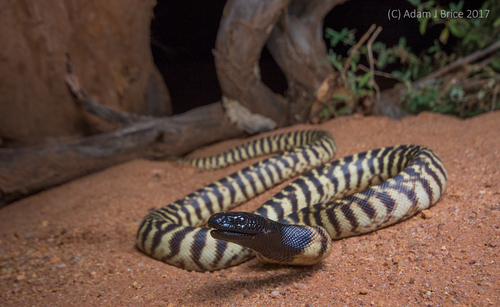
Description: Adult A. melanocephalus typically reach a total length of 1.5–2 m (4.9–6.6 ft) including the tail, with a maximum recorded length of 3.5 m (11 ft). They have a muscular body with a flattened profile, and a tail that tapers to a thin point. Large symmetrical scales cover the top of the head. Smooth, glossy dorsal scales form 50 to 65 rows at midbody, and there are between 315 and 355 ventral scales. The tail has 60 to 75 mostly single subcaudal scales, the anal scale is single, and posterior subcaudals are often irregularly divided. The species has a color pattern made up of black, dark grey, brown, gold, and cream shades arranged in bands or brindling. The light-colored belly is flecked with darker spots, and the head is shiny black, with this black color extending down the neck and throat for several inches.
Distribution and habitat: A. melanocephalus is native to Australia, where it occurs across the northern half of the country, excluding extremely arid regions. Its type locality is recorded as "Port Denison Bowen", Queensland, Australia, and it lives in habitats ranging from humid tropical to semiarid conditions.
Reproduction: A. melanocephalus is oviparous. Adult females produce clutches of five to 10 eggs, and remain coiled around the eggs to incubate them. Incubation generally lasts 2–3 months before hatching. Young A. melanocephalus will take small prey as soon as two days after hatching. Immature individuals are vulnerable to predation, while adult individuals have no natural predators other than dingos and humans.