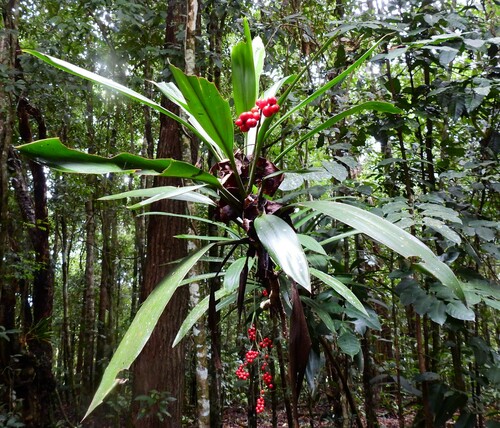
About Aspidistra elatior Blume
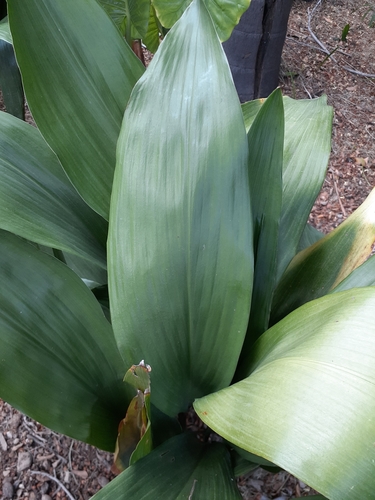
Aspidistra elatior Blume is an evergreen rhizomatous perennial that grows to 60 cm (24 in) tall and wide. It produces glossy dark-green leaves 30–50 cm (12–20 in) long, and fleshy 8-lobed cream flowers with maroon coloring on their inner surface, which bloom in early summer. Though it is sometimes believed to originate from China, this species is actually native to southern Japan, including Kuroshima, Suwanosejima and the Uji Islands. It grows in association with overstorey tree and shrub species Ardisia sieboldii and Castanopsis sieboldii. According to a 2018 published study, A. elatior is primarily pollinated by fungus gnats, specifically Cordyla sixi and Bradysia spp. A. elatior is very well known in cultivation, and has a reputation for tolerating extreme neglect, which led to its common name: cast-iron plant. It can survive low light, low humidity, fluctuating temperatures, and irregular watering. To prevent leaf bleaching, it should be kept out of direct sunlight. It also requires good drainage to grow well and avoid root rot. It is widely grown as a house plant, but can also be grown successfully outdoors in shaded areas of temperate climates. Generally, it can tolerate temperatures down to −15 °C (5 °F), but will be killed by frosts that reach −15 to −20 °C (5 to −4 °F) or lower. This species does not face serious damage from most insects, though mites and scale insects can cause occasional issues. Its leaves and roots may be eaten by hoofed mammals such as deer, as well as rodents and rabbits. The species has received the Royal Horticultural Society's Award of Garden Merit. Several cultivars of A. elatior are available. These include: 'Asahi', whose leaves emerge chocolate brown and turn green starting from the base upward; its Japanese name translates to "morning sun". 'Hoshi-zora', which produces large, faintly speckled leaves; its name translates to "starry sky" in Japanese. 'Lennon's Song', which has long narrow leaf tips and a central stripe of paler green, discovered by American cut foliage grower Robin Lennon. 'Variegata', which has white stripes running along the full length of its leaves, and has also earned the Award of Garden Merit. The plant commonly sold as A. elatior 'Milky Way' is correctly classified as A. lurida 'Ginga'.