About Aspidimorpha sanctaecrucis (Fabricius, 1792)
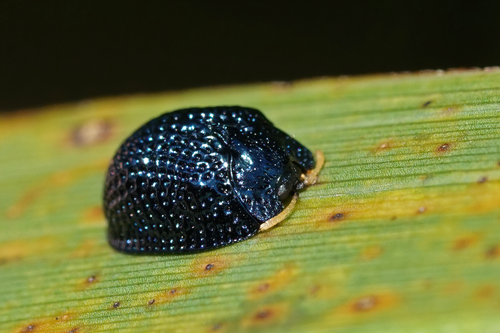
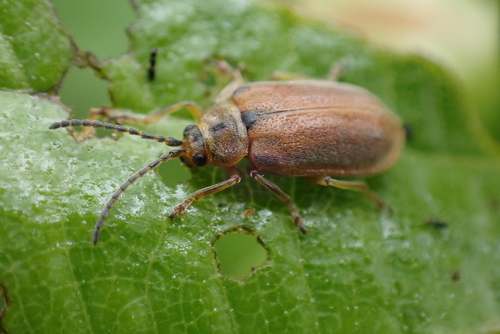
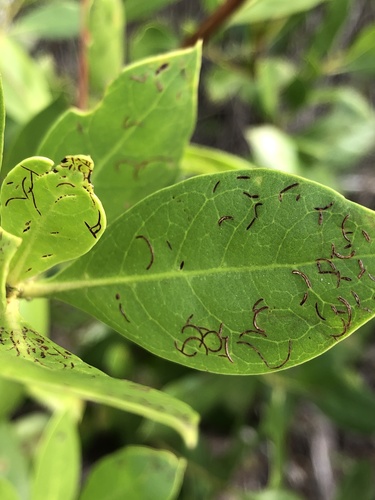
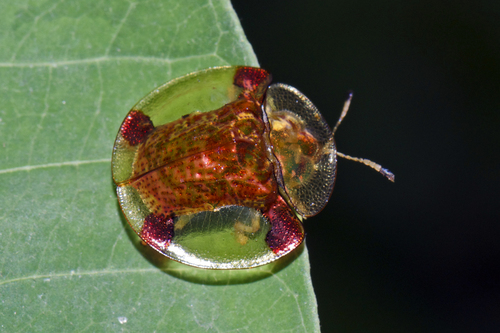
After full development, Aspidimorpha sanctaecrucis has a body length ranging from 15.6 to 16.3 mm and a body width ranging from 14.3 to 14.6 mm. Its elytra range in color from uniform yellow to red brown to brown, with the lateral anterior and posterior corners of the elytral margin visible from the dorsal side. Each elytron has a depression raised along its center, behind the scutellum, with prominently raised margins that end in a dorsal conical hump. There are approximately 9 rows of elytral punctures, and the explanate elytral margins are very broad. The overall body color of A. sanctaecrucis ranges from yellow to brown; its head and body range from yellow to red brown, while its legs and antennae (excluding the final two antennomeres) are uniformly yellow. Its eyes are elliptical, the head has a distinct gena, and the clypeus is depressed medially. Fine clypeal grooves run across the clypeus, and the labrum is emarginate. The explanate margin of the elytra is broader than the width of the elytral disc, and with a body length exceeding 15 mm, this is the largest species of Aspidimorpha found in Kerala, India. A. sanctaecrucis is often confused with A. miliaris, as the two species resemble each other in size and in the shape of the anterior and posterior angles of the elytral margin. However, the prominent ridge and longitudinal depression between the humerus and scutellum at the base of the elytra, along with the presence of a prominent dorsal hump (which is absent in A. miliaris), are distinguishing features that diagnose A. sanctaecrucis. A. sanctaecrucis has been reported from Southwestern India, Central Asia, Southern China, and Southeastern Asia, including Malaysia and Indonesia. It is well adapted to tropical environments, where rainfall is ample but unpredictable, and food resources are available year-round. The species is active during the rainy season and enters diapause in winter and summer. It lives on multiple species in the plant family Convolvulaceae (commonly called morning glories), including Argyreia hookeri, Argyreia cuneata, and Ipomoea carnea. I. carnea is a shrub-like morning glory that grows as a weed in moist soil. It has a robust stem that lets it stand erect until it reaches 200–250 cm tall, at which point it falls to the ground. A. sanctaecrucis can fly between host plants and easily colonize newly formed plant patches, where individuals are less likely to experience wasp parasitism than in older patches. The presence of A. sanctaecrucis on host leaves can be identified by the beetle's irregular feeding pattern. Both larvae and adults feed only on the peripheral margins of the lower leaf surface, leaving holes of variable size. This beetle is widely distributed and is often found living sympatrically with populations of Aspidimorpha miliaris on I. carnea. A. sanctaecrucis lays eggs in a paper-like egg case called an ootheca, placed in aggregates underneath fully opened leaves; the egg masses remain on the leaf after larvae hatch. Clusters can contain 3 to 18 eggs, with an average cluster size of approximately 11 eggs. In one laboratory study that used Ipomoea carnea as a host plant, A. sanctaecrucis was observed to have a total life cycle ranging from 30 to 37 days. This includes an egg incubation period of 7–9 days, five successive larval stages, and a final pupal stage. In a separate study that used Ipomoea batatas as a host, A. miliaris (a coexisting species) was observed to have a life cycle of approximately one month. That study found that the host plant species and its nutritional content significantly affect factors including life cycle length, reproductive rate, mortality rate, lifespan, and body size for the studied species. Currently, no studies have investigated whether these factors affect A. sanctaecrucis, which could be an area for future research.