About Aspicilia cinerea (L.) Körb.
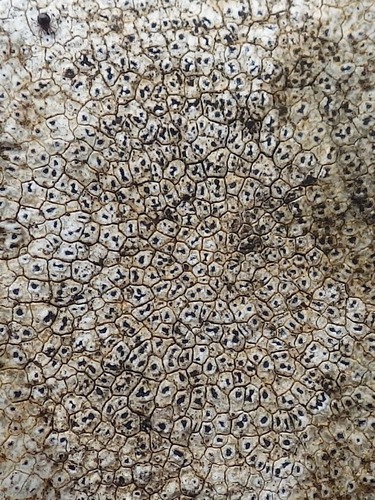
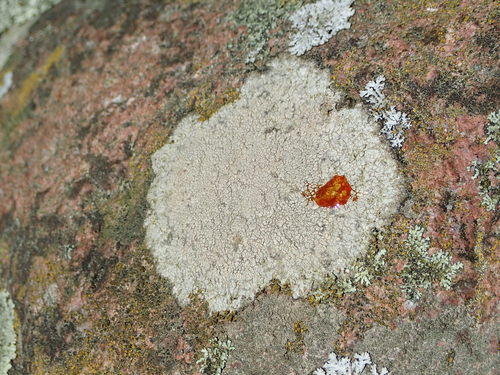
Aspicilia cinerea, commonly called cinder lichen, is a crustose areolate lichen that ranges in color from gray to nearly white. It typically measures 1.5–15 cm (0.59–5.91 in) across, and features large apothecia. It grows mostly on rock in mountain environments, and occurs in a range of forms: from forming a continuous surface to a distinct areolate structure. This lichen is found in Eurasia and North America, where it grows on siliceous rock, schist, or igneous rock in sun-exposed habitats; it only rarely grows on calciferous rock. It is common in Arizona, rare in California and Baja California, and occurs at elevations between 1,700 and 3,300 metres (5,600 to 10,800 ft). Its areoles are flat to slightly convex, angular to irregular in shape, and 0.2–2 mm in diameter. The areoles sit next to one another but are clearly divided by well-defined cracks. A prothallus is usually absent, and the lichen may become rimose toward its outer edges. Each areole holds 1–10 apothecia, which measure 0.1–1.6 mm across and are round, angular, or irregular; apothecia may merge together when numerous. Apothecia usually have black concave discs, with exciple margins made of thallus tissue. Asci are club-shaped (clavate), and each contains 8 ellipsoid ascospores. Lichen spot tests on the cortex and medulla give results of K+ red, KC−, and P+ yellow or P+ orange; the medulla sometimes tests as K+ yellow and P+ orange. Secondary metabolites produced by the lichen include norstictic acid, and often trace amounts of connorstictic acid; hyposalazinic acid occurs more rarely. Its photosynthetic partner (photobiont) is a chlorococcoid green alga.