About Asphondylia solidaginis Beutenmüller, 1907
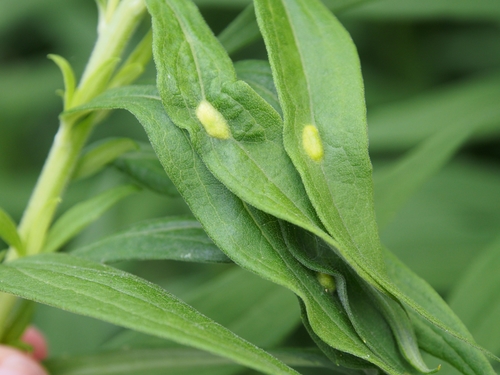
Asphondylia solidaginis is a species of gall midge belonging to the family Cecidomyiidae. It is a widespread species found across North America, where it induces galls on goldenrod plants. It was first formally described by William Beutenmüller in 1907. This gall midge is multivolitine, meaning it produces several generations each year. In spring and early summer, females lay eggs in the leaf buds of Solidago altissima, and sometimes in the leaf buds of Solidago gigantea. After eggs hatch, galls develop on host leaves, and the gall midge larvae live and feed inside these structures. These early-season galls are single-chambered, and appear as blisters on leaves. They typically fuse two leaves together (sometimes up to four leaves) to form a structure called a 'snap' gall, where one leaf forms the gall's base and another forms its top. Adult gall midges emerge from these early galls in June and July. Later in the summer, this species forms leafy rosette galls from the buds of Solidago altissima. It has not been recorded inducing these late-season rosette galls on Solidago gigantea. These rosette galls measure 3 to 5 centimeters in diameter, and contain a single central chamber where larvae live. Other Asphondylia species induce similar snap and rosette galls on other goldenrod species. Adult Asphondylia solidaginis are very similar in appearance to Asphondylia monacha, but the two species can be distinguished by differences in the shape of their pupae. Another gall midge species, Youngomyia podophyllae, has been found inside the galls of Asphondylia solidaginis. It is currently unknown whether Youngomyia podophyllae acts as an inquiline or a parasitoid within these galls.