About Asparagus burchellii Baker
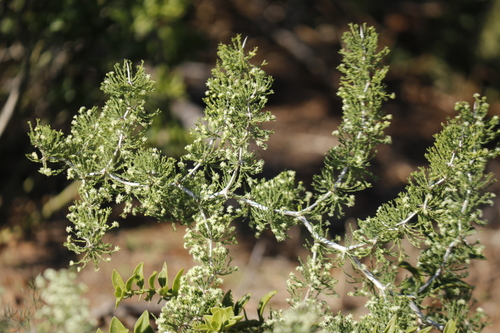
Asparagus burchellii Baker is a perennial shrub that can grow erect, spreading, or climbing, reaching up to 3 metres (9.8 ft) in height. Its stems are twining, zig-zagged, end in spines, have a smooth faintly ridged surface, and start out purple-brown before fading to grey with age. The zig-zagged branches and spines are reflexed or downturned, and the branches curve outwards, a feature that distinguishes this species from Asparagus suaveolens. Groups of 3, 5, or 7 straight-to-curved reflexed spines up to 5 millimetres (0.20 in) long radiate from each stem node. Unlike the smooth spines of Asparagus capensis, the lateral spines of Asparagus burchellii usually have growth nodes on them. Clusters of extremely small leaves, no longer than 3 millimetres (0.12 in), radiate from each node on the branches. The leaf clusters are spreading or ascending, and each individual leaf is cylindrical, tapering at both ends. Very fragrant white flowers grow on stalks in autumn, which differs from the sessile flowers of Asparagus capensis. The fruits are extremely small 3 millimetres (0.12 in) berries that remain green and do not change colour when they ripen. This species is found in South Africa's Eastern Cape Province and Western Cape Province, ranging west as far as Stellenbosch. It is common in scrub, renosterveld, and karoo vegetation types.