About Asparagus africanus Lam.
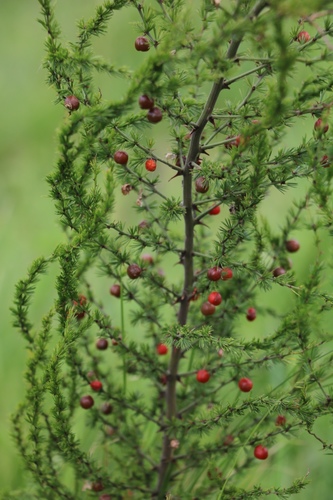
Asparagus africanus Lam. can grow as a spiny shrub up to 1 meter (3.3 feet) tall, or as a climbing plant with stems reaching up to 3 meters (9.8 feet) long; stems up to 12 meters (39 feet) long have also been recorded. This species has a rhizomatous root system that allows it to reshoot, with multiple stems growing from a central crown. Cladodes, which are modified branchlets, grow in bunches at the plant's leaf scales, and each cladode ends in a sharp point. These fern-like cladodes give the species one of its common names: climbing asparagus fern. The plant produces white flowers that, like its foliage, grow in clusters. Flowers have three sepals and three petals that look very similar to each other, six white filaments, and yellow anthers. In the Southern Hemisphere, flowers appear between August and December. Flower color and scent attract insects that pollinate the plant. After pollination, the plant produces round fruits that turn red when ripe. Ripe fruits eventually shrivel to expose a single black seed. Mammals and birds may eat these fruits, which helps the species disperse its seeds. Fruits can form at any time of year when growing conditions are suitable. The berries of Asparagus africanus contain toxic compounds including furostanol, and eating them may cause pain and vomiting. Asparagus africanus is a widely distributed species, found across most of Africa, as well as the Arabian Peninsula and India. It grows in a broad range of habitats, from rainforests to grasslands to semi-deserts. This plant can grow very quickly; when growing as a climbing form, it can rapidly dominate the local canopy and outcompete other native species. It was introduced as an ornamental plant and has since become naturalised in parts of Australia. The new shoots of Asparagus africanus are harvested and eaten as a vegetable, considered a good source of fiber and various vitamins. The roots are also boiled and consumed, while fruits are generally only eaten during periods of famine. Across many cultures, the stems and underground parts of the plant are used to treat a wide variety of health conditions. Laboratory studies on animals have found that this plant improves immune system function, which helps explain its widespread traditional use. It is considered a valuable medicinal plant by communities in Ethiopia. The Zay people of Ethiopia use the plant's cladodes applied to the skin to treat skin lesions, and feed the roots and cladodes to equines to treat geregelcha, a disease that causes continuous mucus discharge from an animal's nose. Root tubers mixed with milk are used after childbirth to help expel the afterbirth, and rural women in Uganda use the plant as a form of birth control. In South Africa, it is used to treat headaches, sexually transmitted infections, stomach aches, sore throats, and malaria, among other conditions. Compounds found in the plant's roots have been shown to be effective as anti-parasitic and anti-protozoan treatments, including activity against Plasmodium falciparum, the deadliest form of human malaria. Methanolic extracts from the roots have also been found to have pain-relieving and anti-inflammatory properties.