About Asparagopsis armata Harv.
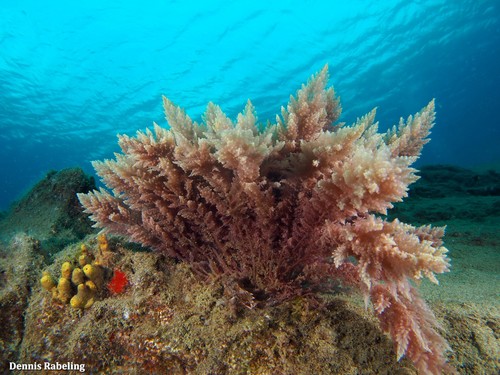
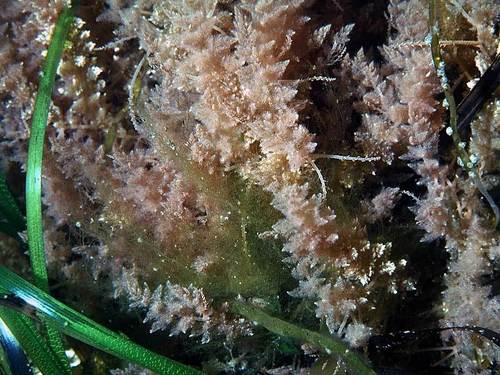
Morphology: Fully grown Asparagopsis armata has sparse branches. Long stolons with harpoon-like hooks and erect shoots grow out in all directions from these branches. Repeated branching of branches, stolons, and shoots gives this alga a thallus-like overall appearance. Its ultimate branchlets are filamentous and made of three cell rows. Larger branches contain a central medullary filament and gelatinous matrix, surrounded by a cortex 3–6 cells thick. Gametophytes are terete, around 200 mm tall, and form dense, pink intertwining clumps. A key identifying feature of this species is barbs, which anchor A. armata to benthic substrates in the ocean.
Population distribution: A. armata is native to southern Australia and New Zealand in the Southern Hemisphere. It is highly invasive, and is thought to have spread slowly to the Northern Hemisphere via the Mediterranean Sea. It can now also be found along the coast from the British Isles to Senegal. The first record of A. armata in the Mediterranean Sea was from Algeria in 1923. When it was first discovered, its presence in this location was surprising, due to the high summer sea surface temperatures along the southern Mediterranean coast. However, it was later found that local summer cool water temperatures that stay below 25 °C allow the species to survive in the area.
Life cycle: A. armata has a triphasic diplohaplontic heteromorphic life cycle. The three phases of this cycle are the haploid carposporophyte, the gametophyte, and the diploid zygote. Multiple phases with different morphology and ploidy each contribute differently to the expansion potential of A. armata. This species has two morphologically distinct developmental stages: the gametophyte stage and the tetrasporophyte stage. In this heteromorphic diplohaplontic life cycle, A. armata alternates between haploid gametophytic and diploid phases. The mature gametophyte undergoes fertilization to produce the diploid carposporophyte, which divides to form tetrasporophytes. Tetrasporophytes undergo meiosis to develop into new gametophytes.